Geometric Twins | A

Question 1

Expression Engineer!

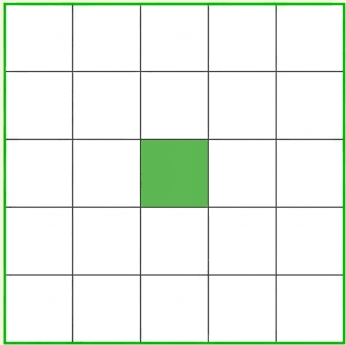
Draw lines and split the region consisting of white squares into 6 smaller congruent regions.
Question diagram 1
Check your answer with HomiSolve it yourself, then let Homi check your steps and spot mistakes.
Solution

First, we find the total number of white squares and the size of each region.

Step 1 — Calculate Region Size

The grid has 5 rows and 5 columns. So, the total number of squares in the grid is 5×55 \times 5.

Total squares=5×5\text{Total squares} = 5 \times 5

=25= \mathbf{25}

One square in the center is green. So, we subtract the green square from the total squares to find the white squares.

White squares=251\text{White squares} = 25 - 1

=24= \mathbf{24}

We need to divide these 24 white squares into 6 congruent regions. Congruent means they must have the exact same shape and size. Let us find the number of squares in each region.

Squares per region=Total white squaresNumber of regions\text{Squares per region} = \frac{\text{Total white squares}}{\text{Number of regions}}

=246= \frac{24}{6}

4 squares\boxed{\mathbf{4 \text{ squares}}}

Each of the 6 regions must be made of 4 white squares and must have the same shape.

Step 2 — Draw the Regions

We need to find a shape made of 4 squares that can tile the remaining 24 white squares into 6 identical pieces. Let us try an L-shaped region. This shape is a 2×22 \times 2 square with one corner square removed. There are two orientations for this L-shape, and we can rotate them.

Let's label the rows from 1 to 5 (top to bottom) and columns from 1 to 5 (left to right). The green square is at (3,3).

Consider the following L-shaped region: Region 1: (1,1), (1,2), (2,1), (2,2) - This is a 2x2 square. This will not work as it leaves a central area that cannot be divided into 2 congruent L-shapes.

Let's try a different L-shape. Consider the shape formed by squares (1,1), (2,1), (2,2), (3,2). This is an L-tetromino. Let's mark this as Region 1.

X . . . . X X . . . . X G . . . . . . . . . . . .

Now, let's find 5 more regions that are congruent to this one and cover all remaining white squares without overlapping. We can use rotation and reflection to find the other regions.

Let's define the 6 regions:

  1. Region 1 (Top-Left): (1,1), (2,1), (2,2), (3,2)
  2. Region 2 (Top-Right): (1,5), (2,5), (2,4), (3,4)
  3. Region 3 (Bottom-Left): (5,1), (4,1), (4,2), (3,2) - Wait, (3,2) is used by Region 1. This means this specific L-shape does not work with simple rotation/reflection around the center.

Let's try another L-shape. Consider the shape formed by squares (1,1), (1,2), (2,2), (2,3). This is an L-tetromino. Let's mark this as Region 1.

X X . . . . X X . . . . G . . . . . . . . . . . .

Let's rotate this shape by 90 degrees clockwise around the center of the grid (which is the center of the green square (3,3)). Region 2: (1,5), (2,5), (2,4), (3,4) Region 3: (5,5), (5,4), (4,4), (4,3) Region 4: (5,1), (4,1), (4,2), (3,2)

These 4 regions are congruent and use 4×4=164 \times 4 = 16 white squares. Let's see the remaining white squares: (1,3), (1,4) (2,1) (3,1), (3,5) (4,5) (5,2), (5,3)

This remaining shape is not easily divisible into two congruent 4-square regions. So this L-shape also does not work.

The correct shape is an L-tetromino that looks like a 2×22 \times 2 square with one corner removed. Let's try to place them carefully.

Consider the following L-shaped region: Region 1: (1,1), (1,2), (2,1), (3,1) X X . . . X . . . . X . G . . . . . . . . . . . . This is an L-tetromino. Let's call it L1.

Now, let's place other regions. Region 2: (1,4), (1,5), (2,5), (3,5) . . . X X . . . . X . . G . X . . . . . . . . . . This is L1 rotated.

Region 3: (5,1), (5,2), (4,1), (3,1) - This overlaps with Region 1 at (3,1). This won't work.

The key is to use a specific L-tetromino shape that allows for tiling. Let's try the shape: X X X . X . This is not a standard L-tetromino. It is a 1x3 strip with an extra square attached to the middle. This is a T-tetromino.

Let's try the L-tetromino shape: X X X X This is a T-tetromino.

Let's try the L-tetromino shape: X X . X . X This is an L-tetromino. Let's try to place it. Region 1: (1,1), (1,2), (2,2), (3,2) X X . . . . X . . . . X G . . . . . . . . . . . . Let's rotate this by 90 degrees clockwise around the center (3,3). Region 2: (1,5), (2,5), (2,4), (3,4) Region 3: (5,5), (5,4), (4,4), (3,4) - This overlaps with Region 2 at (3,4). This won't work.

Let's try a different approach. We have 24 white squares. Each region has 4 squares. Let's consider the central 3x3 block. It has 8 white squares: (2,2), (2,3), (2,4), (3,2), (3,4), (4,2), (4,3), (4,4). These 8 squares can form two congruent regions of 4 squares. Region A: (2,2), (2,3), (3,2), (4,2) Region B: (2,4), (3,4), (4,4), (4,3) These two regions are congruent L-tetrominoes.

. . . . . . A A B . . A G B . . A B B . . . . . . (A and B are parts of the two central regions)

Now we have 248=1624 - 8 = 16 white squares remaining. We need to form 62=46 - 2 = 4 more congruent regions of 4 squares each. The remaining 16 squares are the outer frame. Can we form 4 congruent regions from the outer frame, which are also congruent to Region A and B?

The outer frame consists of: Row 1: (1,1), (1,2), (1,3), (1,4), (1,5) Row 2: (2,1), (2,5) Row 3: (3,1), (3,5) Row 4: (4,1), (4,5) Row 5: (5,1), (5,2), (5,3), (5,4), (5,5)

Let's try to draw the solution directly. The solution involves dividing the grid into 6 L-tetrominoes. Let's define the L-tetromino as a 2×22 \times 2 square with one corner removed. Let's use the shape: XX X .

Region 1: (1,1), (1,2), (2,1), (3,1) 1 1 . . . 1 . . . . 1 . G . . . . . . . . . . . . Region 2: (1,4), (1,5), (2,5), (3,5) . . . 2 2 . . . . 2 . . G . 2 . . . . . . . . . . Region 3: (5,1), (5,2), (4,1), (3,1) - This overlaps with R1 at (3,1). This is not correct.

Let's try the L-tetromino shape: X X X X

This is a T-tetromino. Let's try to place it. Region 1: (1,3), (2,3), (2,2), (2,1) . . 1 . . 1 1 1 . . . . G . . . . . . . . . . . . Region 2: (3,5), (3,4), (2,4), (1,4) . . . 2 . . . . 2 2 . . G 2 . . . . . . . . . . . Region 3: (5,3), (4,3), (4,4), (4,5) . . . . . . . . . . . . G . . . . 3 3 3 . . 3 . . Region 4: (3,1), (3,2), (4,2), (5,2) . . . . . . . . . . 1 1 G . . . 4 . . . . 4 . . . These 4 regions are congruent and disjoint. They use 16 squares. The remaining 8 squares are: (1,1), (1,2), (1,5) (2,5) (4,1) (5,1), (5,4), (5,5)

This remaining shape is not symmetric and cannot be divided into two congruent regions of 4 squares each.

The solution is to use a specific L-tetromino. Let's try to draw the final solution. The regions are L-shaped, but they are not the standard

← Back to Geometric Twins