Question 35
- Numbers are written in a particular sequence in this endless 4-column grid.
(a) Give expressions to generate all the numbers in a given column (1, 2, 3, 4).
(b) In which row and column will the following numbers appear:
(i) 124

(ii) 147

(iii) 201
(c) What number appears in row and column ?
(d) Observe the positions of multiples of 3.
Do you see any pattern in it? List other patterns that you see.
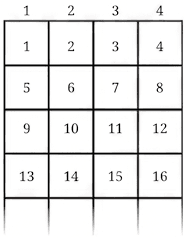
- The endless grid has columns, with numbers filled sequentially across rows: Row 1 has , Row 2 has , and so on.
- Since each row contains numbers, moving down one row in the same column increases the value by .
- The general formula for the number at row and column is:
- To find the row and column for any given number :
- Column corresponds to the remainder when is divided by (if remainder is , ).
- Row is given by .
(a) Give expressions to generate all the numbers in a given column (1, 2, 3, 4).
Step 1 · Derive Expressions for Each Column
Let be the row number (). Since each row contains numbers, numbers in any column increase by with each successive row.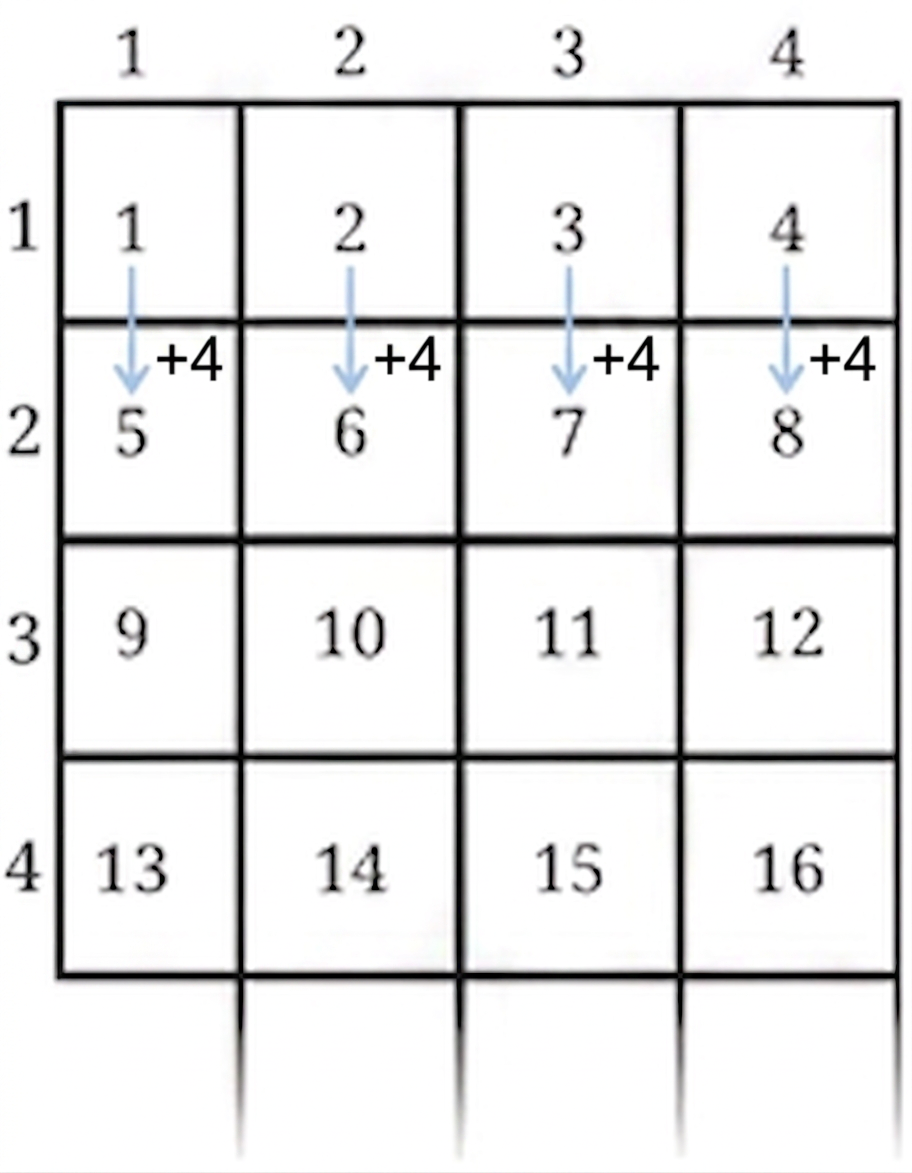
- Column 1:
- Column 2:
- Column 3:
- Column 4:
(a)
**(b) In which row and column will the following numbers appear:
(i) 124

(ii) 147

(iii) 201**
Step 1 · Determine Position for Given Numbers
Using , where is the column determined by :
(i) For :
(ii) For :
(iii) For :
(b) (i) Row , Column
(ii) Row , Column
(iii) Row , Column
(c) What number appears in row and column ?
Step 1 · General Expression
Before row , there are rows containing numbers each. Adding the column offset gives:
(c)
(d) Observe the positions of multiples of 3. Do you see any pattern in it? List other patterns that you see.
Step 1 · Identify Patterns
Listing the positions for the first several multiples of :
Pattern for multiples of 3:
- The column numbers repeat in the cyclic sequence 3, 2, 1, 4 every 4 multiples.
- The row number increases by across each complete repetition of this cycle.
Other patterns:
- Numbers increase by horizontally across any row.
- Numbers increase by vertically down any column.
- All numbers in Column 4 are multiples of .
- All numbers in Column 1 are of the form .
(d) Multiples of follow a repeating column cycle of 3, 2, 1, 4. Other patterns include: column numbers increase by down the grid, row numbers increase by from left to right, and Column 4 contains all multiples of .
- Zero Remainder Confusion: When is perfectly divisible by (remainder ), the number is in Column 4 (not Column ).
- Off-by-One in Row Calculation: Forgetting to add in or writing instead of in the general term.
More questions in IT
Context: Let denote Aftab's age and denote Shabnam's age. The algebraic expression to find Aftab's age is .
Q. Use this expression to find Aftab's age if Shabnam's age is 20.
How much should she pay if she buys 8 coconuts and 9 kg jaggery?
Use this expression (or formula) to find the total amount to be paid for 7 coconuts and 4 kg jaggery.
What is the perimeter of a square with sidelength ? Use the expression to find out.
Now, find the values of the other arithmetic expressions:
Context: Consider the number sequence:
Q. Find an algebraic expression to get the term of this sequence.
Mind the Mistake, Mend the Mistake
Some simplifications are shown below where the letter-numbers are replaced by numbers and the value of the expression is obtained.
- Observe each of them and identify if there is a mistake.
- If you think there is a mistake, try to explain what might have gone wrong.
- Then, correct it and give the value of the expression.
Context: Example 5: Here is a table showing the number of pencils and erasers sold in a shop. The price per pencil is , and the price per eraser is .
The total money earned by the sale of pencils is .
Q. If , find the total amount earned by the sale of pencils.
Context: Example 5: Here is a table showing the number of pencils and erasers sold in a shop. The price per pencil is , and the price per eraser is . Find the total money earned by the shopkeeper during these three days.
Q. Write the expression for the total money earned by selling erasers. Then, simplify the expression.
Context: In this problem, we saw the expression getting simplified to the expression .
Q. Check that both expressions take the same value when is replaced by different numbers.
Context: The expression is simplified to , which is the total amount paid in rupees.
Q. Could we have written the initial expression as ?
Context: The total amount in rupees paid at the beginning is , and the total amount returned is . So, the total amount paid = .
Q. Can we simplify this expression? If yes, how? If not, why not?
What if there is no penalty? What will be the value of in that situation?
Context: In a quiz, represents the score for a correct answer and represents the penalty for an incorrect answer. Krishita's total score after three rounds is .
Q. Give some possible scores for Krishita in the three rounds so that they add up to give .
Context: Charu's total score after three rounds is , and Krishita's total score is , where represents the score for a correct answer and represents the penalty for an incorrect answer.
Q. Can we say who scored more? Can you explain why?
Context: Consider the expression representing the difference between Krishita's and Charu's scores: .
Q. Simplify this expression further.
Fill the blanks below by replacing the letter-numbers by numbers; an example is shown. Then compare the values that and take.
Context: Let us compare the values that the expressions and take for different values of .
Q. After filling in the two diagrams, do you think the two expressions are equal?
Mind the Mistake, Mend the Mistake
Some simplifications of algebraic expressions are done below. The expression on the right-hand side should be in its simplest form.
- Observe each of them and see if there is a mistake.
- If you think there is a mistake, try to explain what might have gone wrong.
- Then, simplify it correctly.
Take a look at all the corrected simplest forms (i.e. brackets are removed, like terms are added, and terms with only numbers are also added). Is there any relation between the number of terms and the number of letter-numbers these expressions have?
Find the formulas of the number machines below and write the expression for each set of inputs.
Now, make a formula on your own. Write a few number machines as examples using that formula. Challenge your classmates to figure it out!
Context: Design C appears at positions that are multiples of 3 (remainder 0). Design B appears at positions that are 1 less than a multiple of 3 (remainder 2). Design A appears at positions that are 2 less than a multiple of 3 (remainder 1).
(a) Can the remainder obtained by dividing the position number by 3 be used for this? Observe the table below.
(b) Use this to find what design appears at positions 99, 122, and 148.
Context: Let us take the marked square, and consider the numbers lying on the diagonals; 12 and 20; 13 and 19. Find their sums; , . What do you observe? They are equal. Let us extend the numbers in the calendar beyond 30, creating endless rows.
Q. Will the diagonal sums be equal in every square in this endless grid? How can we be sure?
Context: Let us consider a square. Its top left number can be any number. Let us call it .
Q. Given that we know the top left number, how do we find the other numbers in this square?
Verify this expression for diagonal sums by considering any square and taking its top left number to be .
Context: Consider a set of numbers from the calendar (having endless rows) forming under the following shape:
Q. Find the sum of all the numbers. Compare it with the number in the centre: 15. Repeat this for another set of numbers that forms this shape. What do you observe?
Q. Will this always happen? How do you show this?
[Hint: Consider a general set of numbers that forms this shape. Take the number at the centre to be . Express the other numbers in terms of .]
Context: Consider a set of numbers from the calendar (having endless rows) forming under the following shape:
We see that the total sum is always 5 times the number in the centre.
Q. Find other shapes for which the sum of the numbers within the figure is always a multiple of one of the numbers.
How many matchsticks will there be in Step 33, Step 84, and Step 108? Of course, we can draw and count, but is there a quicker way to find the answers using the pattern present here?
The number of matchsticks needed to make 33 triangles (Step 33) is ________. Similarly, find the number of matchsticks needed for Step 84 and Step 108.
Context: The expressions describing the rule/formula to find the number of matchsticks at step are and .
Q. Does the above expression also give the number of matchsticks at each step correctly? Are these expressions the same?
Context: Matchsticks are placed in two orientations — (a) horizontal ones at the top and bottom, and (b) the ones placed diagonally in the middle. For example, in step 2 there are 2 matchsticks placed horizontally and 3 matchsticks placed diagonally.
Q. What are these numbers in Step 3 and Step 4?
Context: Matchsticks are placed in two orientations — (a) horizontal ones at the top and bottom, and (b) the ones placed diagonally in the middle. For example, in step 2 there are 2 matchsticks placed horizontally and 3 matchsticks placed diagonally.
Q. How does the number of matchsticks change in each orientation as the steps increase? Write an expression for the number of matchsticks at Step in each orientation. Do the two expressions add up to ?
- Numbers are written in a particular sequence in this endless 4-column grid.
(a) Give expressions to generate all the numbers in a given column (1, 2, 3, 4).
(b) In which row and column will the following numbers appear:
(i) 124
(ii) 147
(iii) 201
(c) What number appears in row and column ?
(d) Observe the positions of multiples of 3.
Do you see any pattern in it? List other patterns that you see.