Question 11
Context: Amu, Charan, Madhu, and John went to a hotel and ordered four dosas. Each dosa cost ₹23, and they wish to thank the waiter by tipping ₹5.
Q. If the total number of friends goes up to 7 and the tip remains the same, how much will they have to pay? Write an expression for this situation and identify its terms.
- Each of the friends orders one dosa costing , so the cost for dosas is .
- A fixed tip of is added to the bill.
- The total amount payable is given by the expression .
- In a mathematical expression, terms are the parts separated by addition () or subtraction () signs.
Step 1 · Calculate Cost of Dosas
Number of dosas , cost per dosa .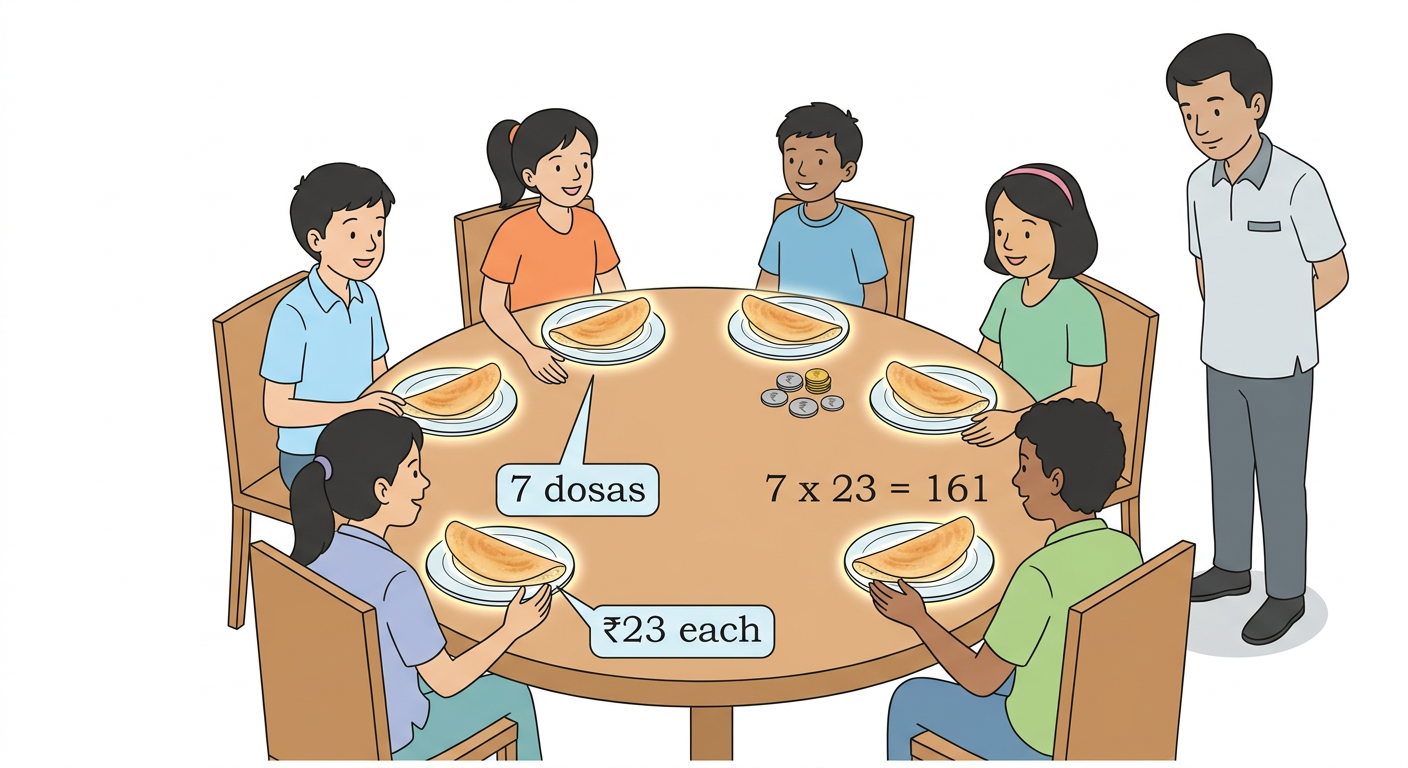
Step 2 · Calculate Total Payment
Adding the tip of
Step 3 · Write the Expression and Identify Terms
The expression representing the total cost is
Terms in an expression are separated by or signs. Therefore, the terms are
Total amount to pay: ₹166
Expression:
Terms: and
- Multiplying the Tip: Tipping is for the whole group, not per person. Writing incorrectly multiplies the tip by .
- Misidentifying Terms: Treating and as separate terms. Since they are multiplied together, forms a single term.
More questions in IT
Choose your favourite number and write as many expressions as you can having that value.
Use '>' or '<' or '=' in each of the following expressions to compare them. Can you do it without complicated calculations? Explain your thinking in each case.
(a)
(b)
(c)
(d)
(e)
Context: Subtracting a number is the same as adding the inverse of the number. Recall that the inverse of a given number has the sign opposite to it. For example, the inverse of is , and the inverse of is . Thus, subtracting from is the same as adding to . That is,
Thus, the terms of the expression are and .
Q. Check if replacing subtraction by addition in this way does not change the value of the expression, by taking different examples.
Can you explain why subtracting a number is the same as adding its inverse, using the Token Model of integers that we saw in the Class 6 textbook of mathematics?
In the following table, some expressions are given. Complete the table.
Does changing the order in which the terms are added give different values?
Context: We already know that swapping the terms does not change the sum when both the terms are positive numbers.
Q. Will this also hold when there are terms having negative numbers as well? Take some more expressions and check.
Context: While adding positive numbers, grouping them in different ways gives the same sum:
Q. Will this also hold when there are terms having negative numbers as well? Take some more expressions and check.
Manasa is adding a long list of numbers. It took her five minutes to add them all and she got the answer 11749. Then she realised that she had forgotten to include the fourth number 9055. Does she have to start all over again?
Manasa is going outside to play. Her mother says, "Wear your hat and shoes!" Which one should she wear first? She can wear her hat first and then her shoes. Or she can wear her shoes first and then her hat.
Manasa will look exactly the same in both cases. Imagine a different situation: Manasa's mother says "Wear your socks and shoes!" Now the order matters. She should wear socks and then shoes. If she wears shoes and then socks, Manasa will feel very uncomfortable and look very different.
Context: Amu, Charan, Madhu, and John went to a hotel and ordered four dosas. Each dosa cost ₹23, and they wish to thank the waiter by tipping ₹5.
Q. If the total number of friends goes up to 7 and the tip remains the same, how much will they have to pay? Write an expression for this situation and identify its terms.
Context: Children in a class are playing "Fire in the mountain, run, run, run!". Whenever the teacher calls out a number, students are supposed to arrange themselves in groups of that number. Whoever is not part of the announced group size, is out. Ruby wanted to rest and sat on one side. The other 33 students were playing the game in the class. The teacher called out '5'. Once children settled, Ruby wrote (understood as 3 more than ).
Q. Think and discuss why she wrote this.
For each of the cases below, write the expression and identify its terms:
(a) If the teacher had called out '4', Ruby would write
(b) If the teacher had called out '7', Ruby would write
Write expressions like the above for your class size.
Context: We have already come across simple expressions like , , , and so on. For example, to form , we first form and then add to it. To form , we first form and then subtract from it.
Q. Identify the terms in the two expressions above.
Context: Dinu paid Kiran ₹432 using four ₹100 notes, three ₹10 notes, and two ₹1 coins.
Q. Can you think of some more ways of giving ₹432 to someone?
Context: Together they have to pay . This is also the same as paying for two vegetable cutlets and two rasgullas:
Therefore,
Q. If another friend, Sangmu, joins them and orders the same items, what will be the expression for the total amount to be paid?
. Can you explain why?
Is ?
Use this method to find the following products:
(a)
(b)
(c)
Is this quicker than the multiplication procedure you use generally?
Context: Use this method to find the following products: (a) (b) (c)
Is this quicker than the multiplication procedure you use generally?
Q. Which other products might be quicker to find like the ones above?