Question 24
There is only one supercell (number greater than all its neighbours) in this grid. If you exchange two digits of one of the numbers, there will be 4 supercells. Figure out which digits to swap.
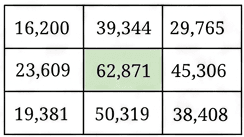
- A supercell is a cell whose value is greater than all its adjacent neighbours (top, bottom, left, and right).
- In the given grid, the center cell is initially the only supercell because it is greater than all surrounding numbers.
- Notice that each of the four edge cells (, , , and ) is already strictly greater than its neighboring corner cells.
- The only neighbor preventing all four edge cells from being supercells is the large center cell . By swapping digits in to make it smaller than all four edge cells, all four will simultaneously become supercells.
Step 1 · Analyze the Original Grid
Consider the given grid: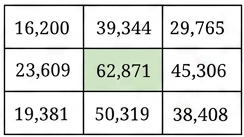
Comparing each edge cell with its adjacent corner neighbours:
- Top-middle (): and
- Middle-left (): and
- Middle-right (): and
- Bottom-middle (): and
Currently, none of these four are supercells only because each is adjacent to the center cell , which is larger than all of them.
Step 2 · Swap Digits in the Center Cell
To make all four edge cells supercells at the same time, the center cell must become smaller than the smallest edge cell ().
Swap the digits and in :
The new grid is:
Now verify the four supercells:
There are now exactly supercells.
Swap the digits and in the center number (to make it ).
- Trying to increase corner cells: Trying to swap digits inside corner cells to make them larger than is impossible (e.g., the largest from is only ).
- Incorrect digit swap: Swapping and in gives , which is still larger than , so the left cell would not become a supercell. Swapping and gives , successfully unlocking all supercells.
More questions in FIO
Colour or mark the supercells in the table below.
Fill the table below with only 4-digit numbers such that the supercells are exactly the coloured cells.
Fill the table below such that we get as many supercells as possible. Use numbers between 100 and 1000 without repetitions.
Out of the 9 numbers, how many supercells are there in the table above?
Find out how many supercells are possible for different numbers of cells.
Do you notice any pattern? What is the method to fill a given table to get the maximum number of supercells? Explore and share your strategy.
Can you fill a supercell table without repeating numbers such that there are no supercells? Why or why not?
Will the cell having the largest number in a table always be a supercell? Can the cell having the smallest number in a table be a supercell? Why or why not?
Fill a table such that the cell having the second largest number is not a supercell.
Fill a table such that the cell having the second largest number is not a supercell but the second smallest number is a supercell. Is it possible?
Make other variations of this puzzle and challenge your classmates.
Identify the numbers marked on the number lines below, and label the remaining positions.
Put a circle around the smallest number and a box around the largest number in each of the sequences above.
Digit sum 14 a. Write other numbers whose digits add up to 14. b. What is the smallest number whose digit sum is 14? c. What is the largest 5-digit whose digit sum is 14? d. How big a number can you form having the digit sum of 14? Can you make an even bigger number?
Find out the digit sums of all the numbers from 40 to 70. Share your observations with the class.
Calculate the digit sums of 3-digit numbers whose digits are consecutive (for example, 345). Do you see a pattern? Will this pattern continue?
Pratibha uses the digits '4', '7', '3' and '2', and makes the smallest and largest 4-digit numbers with them: and . The difference between these two numbers is . The sum of these two numbers is . Choose 4-digits to make:
a. the difference between the largest and smallest numbers greater than .
b. the difference between the largest and smallest numbers less than .
c. the sum of the largest and smallest numbers greater than .
d. the sum of the largest and smallest numbers less than .
What is the sum of the smallest and largest 5-digit palindrome? What is their difference?
The time now is 10:01. How many minutes until the clock shows the next palindromic time? What about the one after that?
How many rounds does the number 5683 take to reach the Kaprekar constant?
Write an example for each of the scenarios shown in the diagram whenever possible.
Always, Sometimes, Never?
Below are some statements. Think, explore and find out if each of the statement is 'Always true', 'Only sometimes true' or 'Never true'. Why do you think so? Write your reasoning and discuss this with the class.
a. 5-digit number + 5-digit number gives a 5-digit number
b. 4-digit number + 2-digit number gives a 4-digit number
c. 4-digit number + 2-digit number gives a 6-digit number
d. 5-digit number – 5-digit number gives a 5-digit number
e. 5-digit number – 2-digit number gives a 3-digit number
Steps you would take to walk: a. From the place you are sitting to the classroom door b. Across the school ground from start to end c. From your classroom door to the school gate d. From your school to your home
Number of times you blink your eyes or number of breaths you take: a. In a minute b. In an hour c. In a day
Name some objects around you that are: a. a few thousand in number b. more than ten thousand in number
There is only one supercell (number greater than all its neighbours) in this grid. If you exchange two digits of one of the numbers, there will be 4 supercells. Figure out which digits to swap.
How many rounds does your year of birth take to reach the Kaprekar constant?
We are the group of 5-digit numbers between 35,000 and 75,000 such that all of our digits are odd. Who is the largest number in our group? Who is the smallest number in our group? Who among us is the closest to 50,000?
Estimate the number of holidays you get in a year including weekends, festivals and vacation. Then, try to get an exact number and see how close your estimate is.
Estimate the number of liters a mug, a bucket and an overhead tank can hold.
Write one 5-digit number and two 3-digit numbers such that their sum is 18,670.
Choose a number between 210 and 390. Create a number pattern similar to those shown in Section 3.9 that will sum up to this number.
Recall the sequence of Powers of 2 from Chapter 1, Table 1. Why is the Collatz conjecture correct for all the starting numbers in this sequence?
Check if the Collatz Conjecture holds for the starting number 100.
Starting with 0, players alternate adding numbers between 1 and 3. The first person to reach 22 wins. What is the winning strategy now?