Question 6
A group of children stand in a line. Each child says a number ('0', '1', or '2') representing the number of taller neighbors standing next to them.
Q. There are 5 children in a group, all of different heights. Can they stand such that four of them say '1' and the last one says '0'? Why or why not?
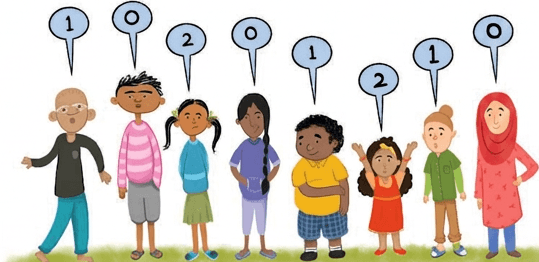
- Each child states the count of taller neighbors standing immediately next to them in a line.
- A child at the end has neighbor, while a child in the middle has neighbors.
- The tallest child has no one taller, so they always say '0'.
- The shortest child has everyone taller than them. If placed in the middle, they would have taller neighbors and say '2'. Thus, the shortest child must stand at one of the ends to say '1'.
- We can test whether arranging the children in monotonic order of height (from shortest to tallest or tallest to shortest) satisfies the condition.
Step 1 · Determine Constraints on the Shortest and Tallest Children
- Tallest child: Since no one is taller, the tallest child has taller neighbors regardless of position and always says '0'.
- Shortest child: Everyone is taller than the shortest child. If the shortest child is in the middle, both neighbors are taller, resulting in a count of '2'. Since no child says '2', the shortest child must be at one of the two ends, having only neighbor and thus saying '1'.
Step 2 · Verify an Arrangement in Ascending Order of Height
Let the 5 children be numbered in increasing order of height, where Child is the shortest and Child is the tallest.
Arrange them from left to right as: Checking the number of taller neighbors for each child:
- Child 1 (End): Only neighbor is Child 2 (taller) says '1'.
- Child 2 (Middle): Neighbors are Child 1 (shorter) and Child 3 (taller) taller neighbor says '1'.
- Child 3 (Middle): Neighbors are Child 2 (shorter) and Child 4 (taller) taller neighbor says '1'.
- Child 4 (Middle): Neighbors are Child 3 (shorter) and Child 5 (taller) taller neighbor says '1'.
- Child 5 (End): Only neighbor is Child 4 (shorter) taller neighbors says '0'.
Thus, exactly four children say '1' and one child says '0'.
Yes, they can stand in increasing (or decreasing) order of height so that four children say '1' and one child says '0'.
- Placing the Shortest Child in the Middle: Putting the shortest child between two others forces them to have taller neighbors, which results in saying '2'.
- Assuming the Tallest Child Must Be in the Middle: The tallest child always has taller neighbors no matter where they stand in line.
More questions in IT
Think about various situations where we use numbers. List five different situations in which numbers are used. See what your classmates have listed, share, and discuss.
Some children in a park are standing in a line. Each one says a number.
Q. What do you think these numbers mean?
group of children stand in a line. Each child says a number ('0', '1', or '2') representing the number of taller neighbors standing next to them.
Q. Can the children rearrange themselves so that the children standing at the ends say '2'?
A group of children stand in a line. Each child says a number ('0', '1', or '2') representing the number of taller neighbors standing next to them.
Q. Can we arrange the children in a line so that all would say only 0s?
A group of children stand in a line. Each child says a number ('0', '1', or '2') representing the number of taller neighbors standing next to them.
Q. Can two children standing next to each other say the same number?
A group of children stand in a line. Each child says a number ('0', '1', or '2') representing the number of taller neighbors standing next to them.
Q. There are 5 children in a group, all of different heights. Can they stand such that four of them say '1' and the last one says '0'? Why or why not?
A group of children stand in a line. Each child says a number ('', '', or '') representing the number of taller neighbors standing next to them.
Q. For this group of 5 children, is the sequence possible?
A group of children stand in a line. Each child says a number ('0', '1', or '2') representing the number of taller neighbors standing next to them.
Q. Is the sequence possible? Why or why not?
A group of children stand in a line. Each child says a number ('0', '1', or '2') representing the number of taller neighbors standing next to them.
Q. How would you rearrange the five children so that the maximum number of children say '2'?
Find out how many numbers have two digits, three digits, four digits, and five digits.
Among the numbers 1–100, how many times will the digit ‘7’ occur? Among the numbers 1–1000, how many times will the digit ‘7’ occur?
Consider the digits , , .
Q. Write all possible 3-digit palindromes using these digits.
Try the same procedure for some other numbers, and perform the same steps. Stop if you get a palindrome. There are numbers for which you have to repeat this a large number of times. Are there numbers for which you do not reach a palindrome at all?
I am a 5-digit palindrome. I am an odd number. My 't' digit is double of my 'u' digit. My 'h' digit is double of my 't' digit. Who am I? _____________
What happens if we continue doing this?
Try and find out all possible times on a 12-hour clock of each of these types.
Manish has his birthday on 20/12/2012 where the digits '2', '0', '1', '2' repeat in that order.
Q. Find some other dates of this form from the past.
His sister, Meghana, has her birthday on 11/02/2011 where the digits read the same from left to right and from right to left.
Q. Find all possible dates of this form from the past.
But, will any year's calendar repeat again after some years? Will all dates and days in a year match exactly with that of another year?
Observe the figure below. What can you say about the numbers and the lines drawn?
Numbers in the middle column are added in different ways to get the numbers on the sides (). The numbers in the middle can be used as many times as needed to get the desired sum. Draw arrows from the middle to the numbers on the sides to obtain the desired sums.
Two examples are given. It is simpler to do it mentally!
Can we make 1,000 using the numbers in the middle? Why not? What about 14,000, 15,000 and 16,000? Yes, it is possible. Explore how. What thousands cannot be made?
Using the numbers in the boxes, we are allowed to use both addition and subtraction to get the required number. Complete the equations shown in the diagram.
3.9 Playing with Number Patterns
Here are some numbers arranged in some patterns. Find out the sum of the numbers in each of the below figures. Should we add them one by one or can we use a quicker way?
Share and discuss in class the different methods each one of you used to solve these questions.
3.10 An Unsolved Mystery—the Collatz Conjecture!
Look at the sequences below—the same rule is applied in all the sequences:
a. 12, 6, 3, 10, 5, 16, 8, 4, 2, 1
b. 17, 52, 26, 13, 40, 20, 10, 5, 16, 8, 4, 2, 1
c. 21, 64, 32, 16, 8, 4, 2, 1
d. 22, 11, 34, 17, 52, 26, 13, 40, 20, 10, 5, 16, 8, 4, 2, 1
Do you see how these sequences were formed?
Estimate the answer
Try to guess within 30 seconds. Check your guess with your friends.
Number of words in your maths textbook: a. More than 5000 b. Less than 5000
Estimate the answer
Try to guess within 30 seconds. Check your guess with your friends.
Number of students in your school who travel to school by bus: a. More than 200 b. Less than 200
Estimate the answer
Try to guess within 30 seconds. Check your guess with your friends.
Roshan wants to buy milk and 3 types of fruit to make fruit custard for 5 people. He estimates the cost to be ₹100. Do you agree with him? Why or why not?
Estimate the answer
Try to guess within 30 seconds. Check your guess with your friends.
Estimate the distance between Gandhinagar (in Gujarat) to Kohima (in Nagaland). Hint: Look at the map of India to locate these cities.
Sheetal is in Grade 6 and says she has spent around 13,000 hours in school till date. Do you agree with her? Why or why not?
Earlier, people used to walk long distances as they had no other means of transport. Suppose you walk at your normal pace. Approximately, how long would it take you to go from:
a. Your current location to one of your favourite places nearby. b. Your current location to any neighbouring state's capital city. c. The southernmost point in India to the northernmost point in India.
Make some estimation questions and challenge your classmates!