Question 25
Name the different angles in the figure and write their measures.
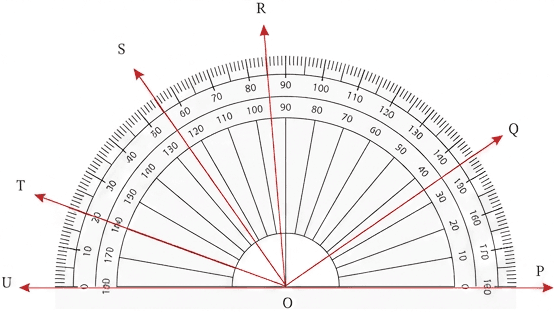
- A protractor placed at vertex allows us to measure angles formed by the rays and .
- The measure of any angle between two rays is found by subtracting the smaller reading from the larger reading along the same protractor scale:
Step 1 · Identify Ray Positions on the Protractor
Align the center of the protractor at point with base line . Reading the inner scale starting from ray at :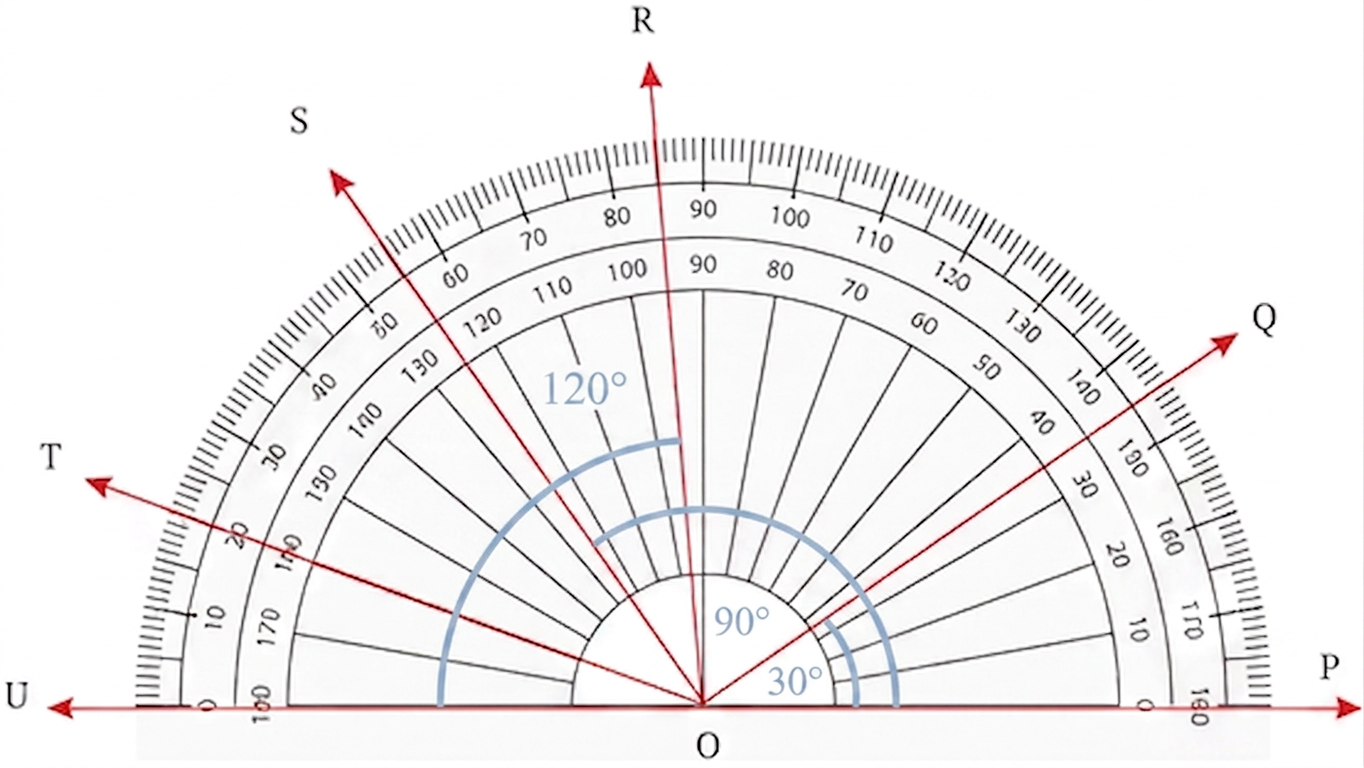
Step 2 · Calculate Angle Measures
Subtract the smaller degree reading from the larger degree reading for each pair of rays:
Angles starting with ray :
Angles starting with ray :
Angles starting with ray :
Angles starting with ray :
Angle starting with ray :
- Mixing Inner and Outer Scales: Always use the same scale (inner or outer) for both rays when finding the difference to avoid incorrect angle values.
- Missing Non-Adjacent Angles: Don't only name adjacent angles like and ; composite angles such as and must also be included.
More questions in FIO
- Rihan marked a point on a piece of paper. How many lines can he draw that pass through the point?
- Sheetal marked two points on a piece of paper. How many different lines can she draw that pass through both of the points?
Can you help Rihan and Sheetal find their answers?
Name the line segments in Fig. 2.4. Which of the five marked points are on exactly one of the line segments? Which are on two of the line segments?
Name the rays shown in Fig. 2.5. Is the starting point of each of these rays?
Draw a rough figure and write labels appropriately to illustrate each of the following:
a. and meet at O.
b. and intersect at point M.
c. Line contains points E and F but not point D.
d. Point P lies on .
In Fig. 2.6, name:
a. Five points
b. A line
c. Four rays
d. Five line segments
Here is a ray (Fig. 2.7). It starts at and passes through the point . It also passes through the point .
a. Can you also name it as ? Why?
b. Can we write as ? Why or why not?
Can you find the angles in the given pictures? Draw the rays forming any one of the angles and name the vertex of the angle.
Draw and label an angle with arms and .
Explain why cannot be labelled as .
Name the angles marked in the given figure.
Mark any three points on your paper that are not on one line. Label them , , . Draw all possible lines going through pairs of these points. How many lines do you get? Name them. How many angles can you name using , , ? Write them down, and mark each of them with a curve as in Fig. 2.9.
Now mark any four points on your paper so that no three of them are on one line. Label them , , , . Draw all possible lines going through pairs of these points. How many lines do you get? Name them. How many angles can you name using , , , ? Write them all down, and mark each of them with a curve as in Fig. 2.9.
Fold a rectangular sheet of paper, then draw a line along the fold created. Name and compare the angles formed between the fold and the sides of the paper. Make different angles by folding a rectangular sheet of paper and compare the angles. Which is the largest and smallest angle you made?
In each case, determine which angle is greater and why.
a. or
b. or
c. or
Discuss with your friends on how you decided which one is greater.
Which angle is greater: or ? Give reasons.
How many right angles do the windows of your classroom contain? Do you see other right angles in your classroom?
Join to other grid points in the figure by a straight line to get a straight angle. What are all the different ways of doing it?
Now join to other grid points in the figure by a straight line to get a right angle. What are all the different ways of doing it?
Hint: Extend the line further as shown in the figure below. To get a right angle at , we need to draw a line through it that divides the straight angle into two equal parts.
Get a slanting crease on the paper. Now, try to get another crease that is perpendicular to the slanting crease.
a. How many right angles do you have now? Justify why the angles are exact right angles.
b. Describe how you folded the paper so that any other person who doesn't know the process can simply follow your description to get the right angle.
Identify acute, right, obtuse and straight angles in the previous figures.
Make a few acute angles and a few obtuse angles. Draw them in different orientations.
Do you know what the words acute and obtuse mean? Acute means sharp and obtuse means blunt. Why do you think these words have been chosen?
Find out the number of acute angles in each of the figures below.
What will be the next figure and how many acute angles will it have? Do you notice any pattern in the numbers?
Write the measures of the following angles:
(a)
Notice that the vertex of this angle coincides with the centre of the protractor. So the number of units of 1 degree angle between KA and AL gives the measure of . By counting, we get:
Making use of the medium-sized and large-sized marks, is it possible to count the number of units in 5s or 10s?
(b)
(c)
Name the different angles in the figure and write their measures.
Find the degree measures of the following angles using your protractor.
Find the degree measures of different angles in your classroom using your protractor.
Find the degree measures for the angles given below. Check if your paper protractor can be used here!
How can you find the degree measure of the angle given below using a protractor?
Measure and write the degree measures for each of the following angles:
Find the degree measures of , , and .
Find the degree measures of , and .
Angles in a clock:
a. The hands of a clock make different angles at different times. At 1 o'clock, the angle between the hands is . Why?
b. What will be the angle at 2 o'clock? And at 4 o'clock? 6 o'clock?
c. Explore other angles made by the hands of a clock.
The angle of a door:
Is it possible to express the amount by which a door is opened using an angle? What will be the vertex of the angle and what will be the arms of the angle?
Vidya is enjoying her time on the swing. She notices that the greater the angle with which she starts the swinging, the greater is the speed she achieves on her swing. But where is the angle? Are you able to see any angle?
Here is a toy with slanting slabs attached to its sides; the greater the angles or slopes of the slabs, the faster the balls roll. Can angles be used to describe the slopes of the slabs? What are the arms of each angle? Which arm is visible and which is not?
Observe the images below where there is an insect and its rotated version. Can angles be used to describe the amount of rotation? How? What will be the arms of the angle and the vertex?
Hint: Observe the horizontal line touching the insects.
In Fig. 2.23, list all the angles possible. Did you find them all? Now, guess the measures of all the angles. Then, measure the angles with a protractor. Record all your numbers in a table. See how close your guesses are to the actual measures.
Use a protractor to draw angles having the following degree measures:
a. b. c. d. e.
Draw an angle whose degree measure is the same as the angle given below:
Also, write down the steps you followed to draw the angle.
In each of the below grids, join to other grid points in the figure by a straight line to get:
a. An acute angle
b. An obtuse angle
c. A reflex angle
Mark the intended angles with curves to specify the angles. One has been done for you.
Use a protractor to find the measure of each angle. Then classify each angle as acute, obtuse, right, or reflex.
a. b. c. d.
Draw angles with the following degree measures: a. b. c. d. e.
Estimate the size of each angle and then measure it with a protractor:
a. b. c. d. e. f.
Classify these angles as acute, right, obtuse or reflex angles.
Make any figure with three acute angles, one right angle and two obtuse angles.
Draw the letter 'M' such that the angles on the sides are each and the angle in the middle is .
Draw the letter 'Y' such that the three angles formed are , and .
The Ashoka Chakra has 24 spokes. What is the degree measure of the angle between two spokes next to each other? What is the largest acute angle formed between two spokes?
Puzzle: I am an acute angle. If you double my measure, you get an acute angle. If you triple my measure, you will get an acute angle again. If you quadruple (four times) my measure, you will get an acute angle yet again! But if you multiply my measure by 5, you will get an obtuse angle measure. What are the possibilities for my measure?