Question 3
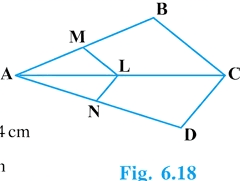
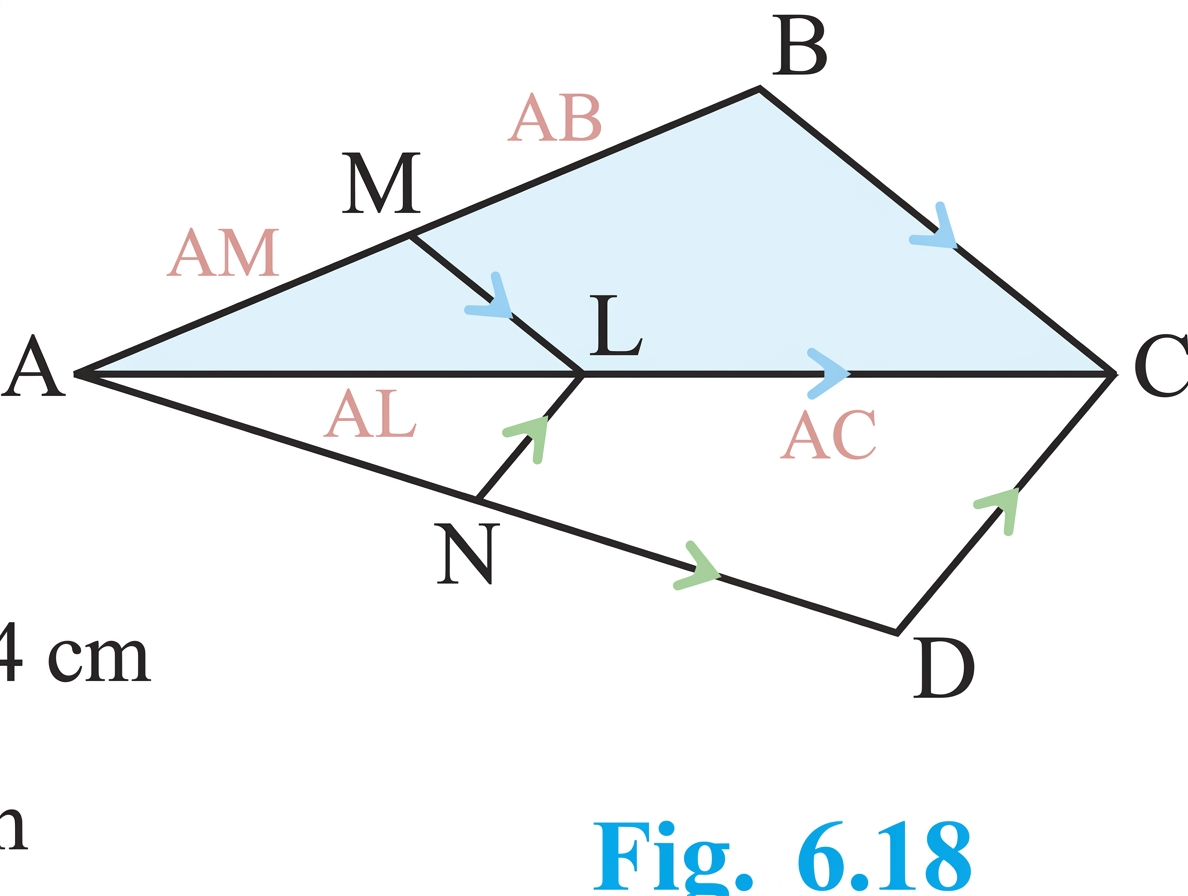
In Fig. 6.18, if LM || CB and LN || CD, prove that
.
We will use the Basic Proportionality Theorem (Thales's Theorem) in two different triangles.
Step 1 — Using BPT in triangle ABC
We are given that line segment is parallel to line segment . Consider triangle . Since , we can apply the Basic Proportionality Theorem. The theorem states that a line parallel to one side of a triangle divides the other two sides proportionally. So, we have the ratio:
Step 2 — Using BPT in triangle ADC
We are given that line segment is parallel to line segment . Consider triangle . Since , we can apply the Basic Proportionality Theorem again. The line divides sides and proportionally. So, we have the ratio:
Step 3 — Comparing the results
Now, let's look at Equation 1 and Equation 2. Both equations have on their right-hand side. This means their left-hand sides must be equal to each other. From Equation 1, we have . From Equation 2, we have . Therefore, we can conclude:
Answer
More questions in Exercise 6.2
In Fig. 6.17, (i) and (ii), DE || BC. Find EC in (i) and AD in (ii).
E and F are points on the sides PQ and PR respectively of a PQR. For each of the following cases, state whether EF || QR :
(i) PE = 3.9 cm, EQ = 3 cm, PF = 3.6 cm and FR = 2.4 cm
(ii) PE = 4 cm, QE = 4.5 cm, PF = 8 cm and RF = 9 cm
(iii) PQ = 1.28 cm, PR = 2.56 cm, PE = 0.18 cm and PF = 0.36 cm
In Fig. 6.18, if LM || CB and LN || CD, prove that
.
In Fig. 6.19, DE || AC and DF || AE. Prove that
.