Question 1
- Solve the following pair of linear equations by the substitution method.
(i)
(ii)
(iii)
(iv)
(v)
(vi)
- The substitution method solves a pair of linear equations by expressing one variable in terms of the other from one equation and substituting it into the second equation.
- This reduces two equations in two variables to a single linear equation in one variable.
- After solving for the first variable, substitute its value back into either equation to find the second variable.
- If substitution leads to an identity that is always true (such as ) with no variables left, the equations represent coincident lines and have infinitely many solutions.
(i) Solve the pair of linear equations by substitution method:
Step 1 · Express and Substitute to Find and
Given
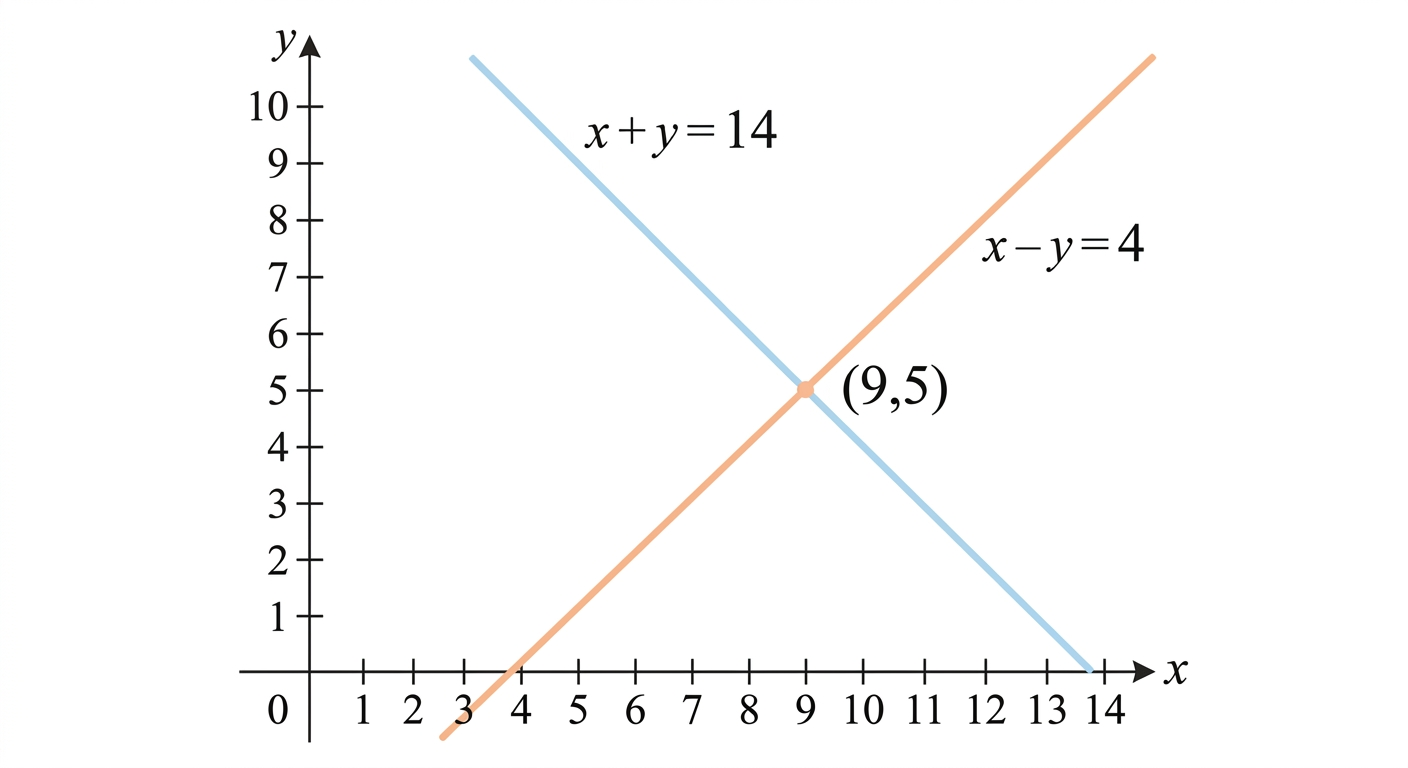
From equation
Substitute into equation
Substitute into
(i)
(ii) Solve the pair of linear equations by substitution method:
Step 1 · Clear Fractions and Solve for and
Given
Multiply equation by to clear fractions
From equation
Substitute into equation
Substitute into
(ii)
(iii) Solve the pair of linear equations by substitution method:
Step 1 · Substitute and Determine the Nature of Solutions
Given
From equation
Substitute into equation
This statement is always true for all values of . Therefore, the equations represent coincident lines and have infinitely many solutions.
(iii) Infinitely many solutions
(iv) Solve the pair of linear equations by substitution method:
Step 1 · Clear Decimals and Solve for and
Given
Multiply equations and by to remove decimals
From equation
Substitute into equation
Substitute into the expression for
(iv)
(v) Solve the pair of linear equations by substitution method:
Step 1 · Solve for and
Given
From equation
Substitute into equation
Multiply by
Substitute into the expression for
(v)
(vi) Solve the pair of linear equations by substitution method:
Step 1 · Clear Fractions and Solve for and
Given
Multiply both equations by to clear fractions
From equation
Substitute into equation
Multiply the entire equation by
Substitute into the expression for
(vi)
- Substituting into the Same Equation: Substituting an expression back into the equation from which it was derived yields an identity (e.g. ) instead of a solution for the variable.
- Fraction/Decimal Clearing Errors: Forgetting to multiply every single term (especially the RHS constant term) when clearing fractions or decimals.
- Sign Errors in Parentheses Expansion: Making sign errors during distribution, such as expanding as instead of .
More questions in Exercise 3.2
- Solve the following pair of linear equations by the substitution method.
(i)
(ii)
(iii)
(iv)
(v)
(vi)
- Solve and and hence find the value of for which .
- Form the pair of linear equations for the following problems and find their solution by substitution method.
(i) The difference between two numbers is 26 and one number is three times the other. Find them.
(ii) The larger of two supplementary angles exceeds the smaller by 18 degrees. Find them.
(iii) The coach of a cricket team buys 7 bats and 6 balls for ₹ 3800. Later, she buys 3 bats and 5 balls for ₹ 1750. Find the cost of each bat and each ball.
(iv) The taxi charges in a city consist of a fixed charge together with the charge for the distance covered. For a distance of 10 km, the charge paid is ₹ 105 and for a journey of 15 km, the charge paid is ₹ 155. What are the fixed charges and the charge per km? How much does a person have to pay for travelling a distance of 25 km?
(v) A fraction becomes , if 2 is added to both the numerator and the denominator. If, 3 is added to both the numerator and the denominator it becomes . Find the fraction.
(vi) Five years hence, the age of Jacob will be three times that of his son. Five years ago, Jacob's age was seven times that of his son. What are their present ages?