Question 2
Write all the other trigonometric ratios of in terms of .
- To express all trigonometric ratios () in terms of , we use the fundamental trigonometric identities:
- Reciprocal identity:
- Pythagorean identities: and
- Reciprocals for remaining ratios: and
Step 1 · Express in Terms of
Using the reciprocal identity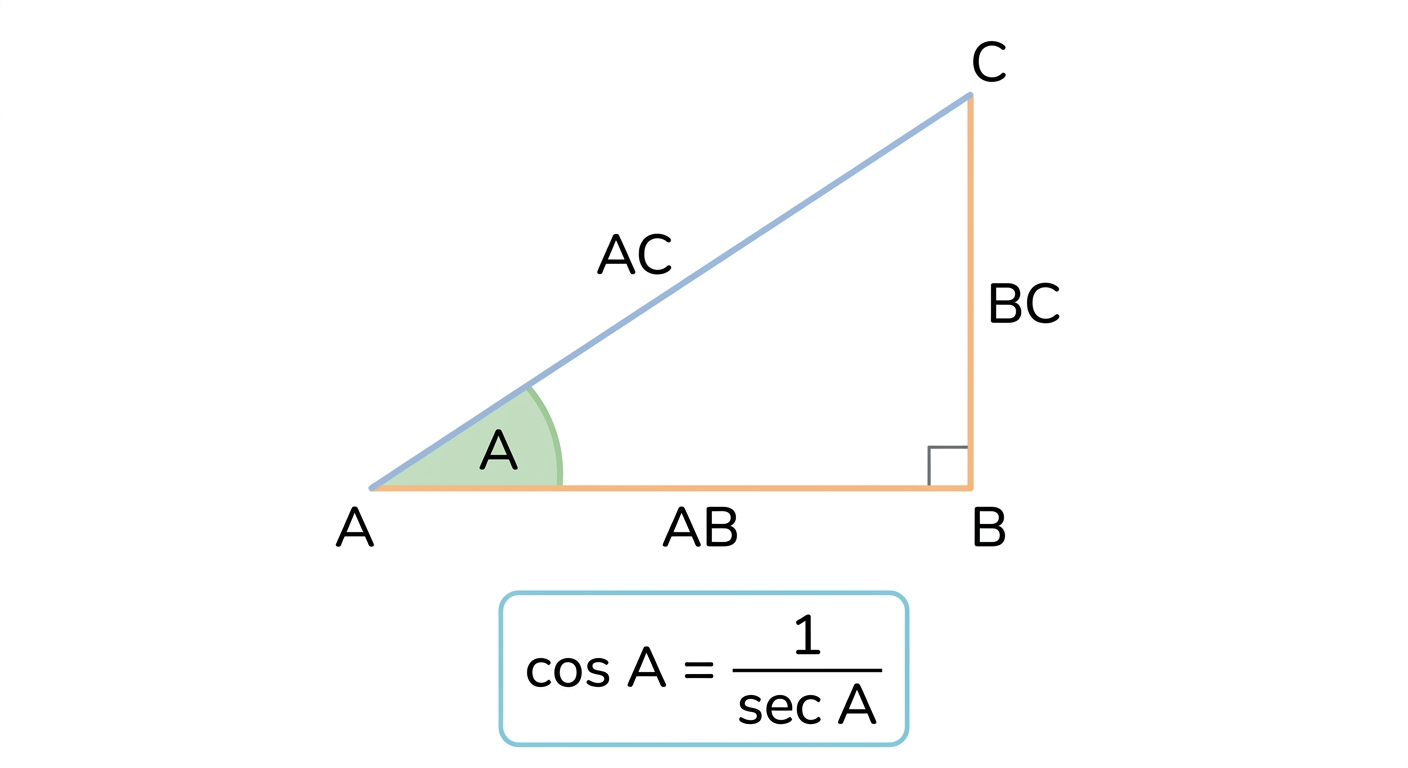
Step 2 · Express in Terms of
Using the identity
Taking the square root on both sides
Step 3 · Express in Terms of
Using the identity
Taking the square root on both sides
Step 4 · Express in Terms of
Using the reciprocal relation
Step 5 · Express in Terms of
Using the reciprocal relation
- Root Simplification Error: Incorrectly simplifying as . A square root cannot be distributed over subtraction.
- Sign of Identity: Confusing with .
- Denominator Under Radical: Forgetting to take the square root of the denominator when finding , writing as instead of dividing by .
More questions in Exercise 8.3
Express the trigonometric ratios , and in terms of .
Write all the other trigonometric ratios of in terms of .
Choose the correct option. Justify your choice.
(i)
(A) (B) (C) (D)
(ii)
(A) (B) (C) (D)
(iii)
(A) (B) (C) (D)
(iv)
(A) (B) (C) (D)
Prove the following identities, where the angles involved are acute angles for which the expressions are defined.
(i)
(ii)
(iii) [Hint : Write the expression in terms of and ]
(iv) [Hint : Simplify LHS and RHS separately]
(v) , using the identity .
(vi)
(vii)
(viii)
(ix) [Hint : Simplify LHS and RHS separately]
(x)