Arithmetic Progressions | Exercise 5.2

Question 3

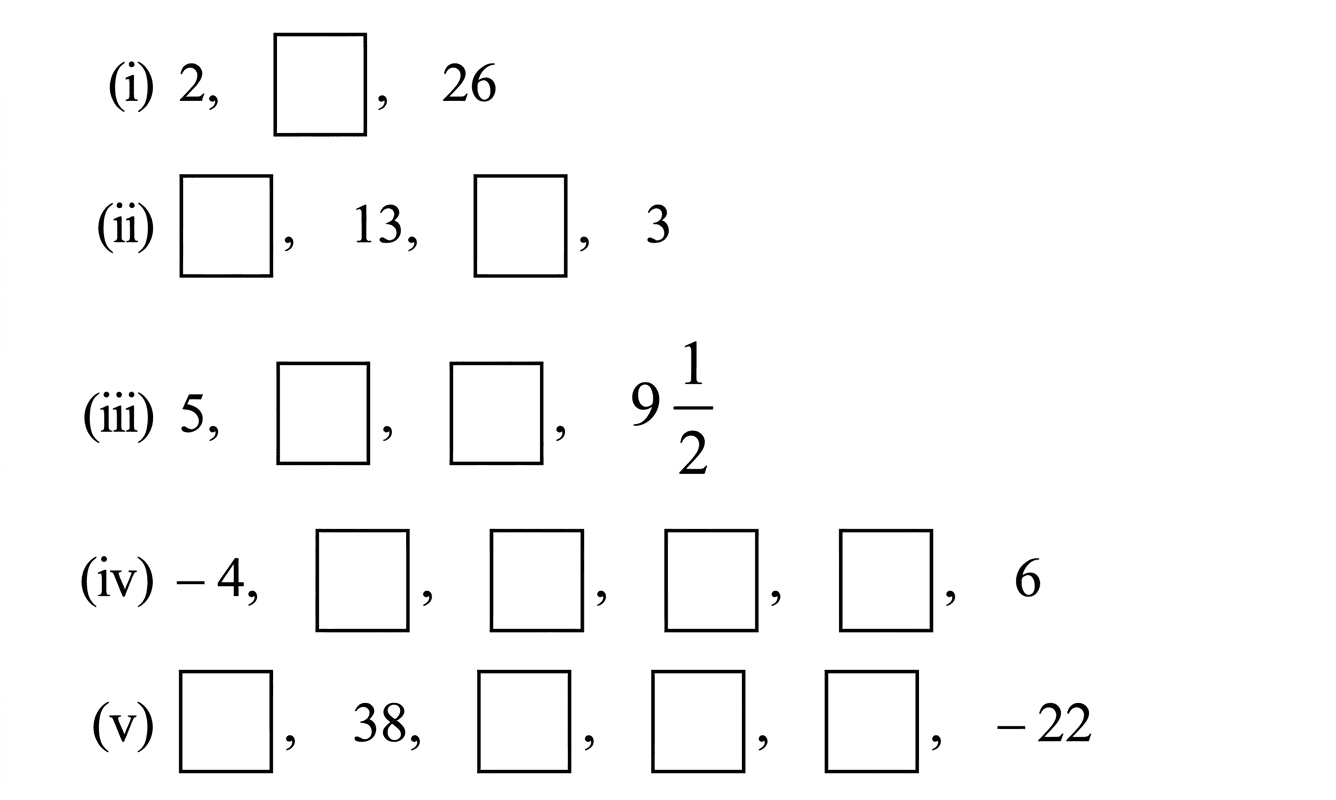
In the following APs, find the missing terms in the boxes :
Question diagram 1
Check your answer with HomiSolve it yourself, then let Homi check your steps and spot mistakes.
Solution
Understand the Question
  • For an Arithmetic Progression (AP), the nn-th term is given by the formula: an=a+(n1)da_n = a + (n - 1)d where aa is the first term, dd is the common difference, and nn is the position of the term.
  • To find the missing terms in each AP:
    1. Identify the given terms and their respective positions (nn).
    2. Set up algebraic equations in terms of aa and dd.
    3. Solve for aa and dd, then calculate the missing terms.

(i) 2,x,262, \boxed{\phantom{x}}, 26

Step 1 · Find Common Difference and Missing Term

Given a1=2a_1 = 2 and a3=26a_3 = 26.

a3=a1+2d26=2+2d24=2dd=12\begin{aligned} a_3 &= a_1 + 2d \\ 26 &= 2 + 2d \\ 24 &= 2d \\ d &= 12 \end{aligned}

Now, calculate the missing term a2a_2:

a2=a1+d=2+12=14\begin{aligned} a_2 &= a_1 + d \\ &= 2 + 12 \\ &= 14 \end{aligned}
Answer

(i) 1414

(ii) x,13,x,3\boxed{\phantom{x}}, 13, \boxed{\phantom{x}}, 3

Step 1 · Find First Term and Common Difference

Given a2=13a_2 = 13 and a4=3a_4 = 3.

a2=a1+d    13=a1+d(1)a4=a1+3d    3=a1+3d(2)\begin{aligned} a_2 &= a_1 + d \implies 13 = a_1 + d \quad \dots (1) \\ a_4 &= a_1 + 3d \implies 3 = a_1 + 3d \quad \dots (2) \end{aligned}

Subtract equation (1)(1) from (2)(2):

(a1+3d)(a1+d)=3132d=10d=5\begin{aligned} (a_1 + 3d) - (a_1 + d) &= 3 - 13 \\ 2d &= -10 \\ d &= -5 \end{aligned}

Substitute d=5d = -5 into equation (1)(1) to find a1a_1:

13=a1+(5)a1=13+5a1=18\begin{aligned} 13 &= a_1 + (-5) \\ a_1 &= 13 + 5 \\ a_1 &= 18 \end{aligned}

Step 2 · Find the Third Term

Calculate a3a_3:

a3=a2+d=13+(5)=8\begin{aligned} a_3 &= a_2 + d \\ &= 13 + (-5) \\ &= 8 \end{aligned}
Answer

(ii) 18,818, 8

(iii) 5,x,x,9125, \boxed{\phantom{x}}, \boxed{\phantom{x}}, 9\dfrac{1}{2}

Step 1 · Find Common Difference

Given a1=5a_1 = 5 and a4=912=192a_4 = 9\dfrac{1}{2} = \dfrac{19}{2}.

a4=a1+3d192=5+3d192102=3d92=3dd=92×3d=32\begin{aligned} a_4 &= a_1 + 3d \\[0.6em] \dfrac{19}{2} &= 5 + 3d \\[0.6em] \dfrac{19}{2} - \dfrac{10}{2} &= 3d \\[0.6em] \dfrac{9}{2} &= 3d \\[0.6em] d &= \dfrac{9}{2 \times 3} \\[0.6em] d &= \dfrac{3}{2} \end{aligned}

Step 2 · Find Missing Terms

Calculate a2a_2 and a3a_3:

a2=a1+d=5+32=102+32=132=612\begin{aligned} a_2 &= a_1 + d \\[0.6em] &= 5 + \dfrac{3}{2} \\[0.6em] &= \dfrac{10}{2} + \dfrac{3}{2} \\[0.6em] &= \dfrac{13}{2} = 6\dfrac{1}{2} \end{aligned} a3=a2+d=132+32=162=8\begin{aligned} a_3 &= a_2 + d \\[0.6em] &= \dfrac{13}{2} + \dfrac{3}{2} \\[0.6em] &= \dfrac{16}{2} \\[0.6em] &= 8 \end{aligned}
Answer

(iii) 132,8\dfrac{13}{2}, 8

(iv) 4,x,x,x,x,6-4, \boxed{\phantom{x}}, \boxed{\phantom{x}}, \boxed{\phantom{x}}, \boxed{\phantom{x}}, 6

Step 1 · Find Common Difference

Given a1=4a_1 = -4 and a6=6a_6 = 6.

a6=a1+5d6=4+5d6+4=5d10=5dd=2\begin{aligned} a_6 &= a_1 + 5d \\ 6 &= -4 + 5d \\ 6 + 4 &= 5d \\ 10 &= 5d \\ d &= 2 \end{aligned}

Step 2 · Find Missing Terms

Calculate a2,a3,a4,a_2, a_3, a_4, and a5a_5:

a2=a1+d=4+2=2a3=a2+d=2+2=0a4=a3+d=0+2=2a5=a4+d=2+2=4\begin{aligned} a_2 &= a_1 + d = -4 + 2 = -2 \\[0.6em] a_3 &= a_2 + d = -2 + 2 = 0 \\[0.6em] a_4 &= a_3 + d = 0 + 2 = 2 \\[0.6em] a_5 &= a_4 + d = 2 + 2 = 4 \end{aligned}
Answer

(iv) 2,0,2,4-2, 0, 2, 4

(v) x,38,x,x,x,22\boxed{\phantom{x}}, 38, \boxed{\phantom{x}}, \boxed{\phantom{x}}, \boxed{\phantom{x}}, -22

Step 1 · Find First Term and Common Difference

Given a2=38a_2 = 38 and a6=22a_6 = -22.

a2=a1+d    38=a1+d(1)a6=a1+5d    22=a1+5d(2)\begin{aligned} a_2 &= a_1 + d \implies 38 = a_1 + d \quad \dots (1) \\ a_6 &= a_1 + 5d \implies -22 = a_1 + 5d \quad \dots (2) \end{aligned}

Subtract equation (1)(1) from (2)(2):

(a1+5d)(a1+d)=22384d=60d=15\begin{aligned} (a_1 + 5d) - (a_1 + d) &= -22 - 38 \\ 4d &= -60 \\ d &= -15 \end{aligned}

Substitute d=15d = -15 into equation (1)(1) to find a1a_1:

38=a1+(15)a1=38+15a1=53\begin{aligned} 38 &= a_1 + (-15) \\ a_1 &= 38 + 15 \\ a_1 &= 53 \end{aligned}

Step 2 · Find Remaining Missing Terms

Calculate a3,a4,a_3, a_4, and a5a_5:

a3=a2+d=38+(15)=23a4=a3+d=23+(15)=8a5=a4+d=8+(15)=7\begin{aligned} a_3 &= a_2 + d = 38 + (-15) = 23 \\[0.6em] a_4 &= a_3 + d = 23 + (-15) = 8 \\[0.6em] a_5 &= a_4 + d = 8 + (-15) = -7 \end{aligned}
Answer

(v) 53,23,8,753, 23, 8, -7

Common Mistakes
  • Counting Total Terms (nn): Misidentifying the position of given terms by skipping empty boxes (e.g., mistaking the 6th6^{\text{th}} term for the 5th5^{\text{th}} term).
  • Negative Common Difference (dd): Making sign errors during subtraction when dd is negative (e.g., 38+(15)38 + (-15) becoming 5353 instead of 2323).
  • Fraction Conversion Errors: Incorrectly converting mixed numbers to improper fractions (e.g., writing 9129\dfrac{1}{2} as 182\dfrac{18}{2} instead of 192\dfrac{19}{2}).

More questions in Exercise 5.2

Q1

Fill in the blanks in the following table, given that aa is the first term, dd the common difference and ana_n the nthn^{\text{th}} term of the AP:

Q2

Choose the correct choice in the following and justify :

(i) 30th term of the AP: 10,7,4,10, 7, 4, \dots, is (A) 9797 (B) 7777 (C) 77-77 (D) 87-87

(ii) 11th term of the AP: 3,12,2,-3, -\dfrac{1}{2}, 2, \dots, is (A) 2828 (B) 2222 (C) 38-38 (D) 4812-48\dfrac{1}{2}

Q3

In the following APs, find the missing terms in the boxes :

Q4

Which term of the AP: 3,8,13,18,3, 8, 13, 18, \dots, is 7878?

Q5

Find the number of terms in each of the following APs:

(i) 7,13,19,,2057, 13, 19, \dots, 205

(ii) 18,1512,13,,4718, 15\dfrac{1}{2}, 13, \dots, -47

Q6

Check whether 150-150 is a term of the AP: 11,8,5,2,11, 8, 5, 2, \dots

Q7

Find the 31st term of an AP whose 11th term is 38 and the 16th term is 73.

Q8

An AP consists of 50 terms of which 3rd term is 12 and the last term is 106. Find the 29th term.

Q9

If the 3rd and the 9th terms of an AP are 44 and 8-8 respectively, which term of this AP is zero?

Q10

The 17th term of an AP exceeds its 10th term by 7. Find the common difference.

Q11

Which term of the AP : 3,15,27,39,3, 15, 27, 39, \dots will be 132132 more than its 54th54^{\text{th}} term?

Q12

Two APs have the same common difference. The difference between their 100th terms is 100, what is the difference between their 1000th terms?

Q13

How many three-digit numbers are divisible by 7?

Q14

How many multiples of 4 lie between 10 and 250?

Q15

For what value of nn, are the nthn^{\text{th}} terms of two APs: 63,65,67,63, 65, 67, \dots and 3,10,17,3, 10, 17, \dots equal?

Q16

Determine the AP whose third term is 16 and the 7th term exceeds the 5th term by 12.

Q17

Find the 20th term from the last term of the AP : 3,8,13,,2533, 8, 13, \dots, 253.

Q18

The sum of the 4th and 8th terms of an AP is 24 and the sum of the 6th and 10th terms is 44. Find the first three terms of the AP.

Q19

Subba Rao started work in 1995 at an annual salary of ₹ 5000 and received an increment of ₹ 200 each year. In which year did his income reach ₹ 7000?

Q20

Ramkali saved ₹ 5 in the first week of a year and then increased her weekly savings by ₹ 1.75. If in the nnth week, her weekly savings become ₹ 20.75, find nn.

← Back to Arithmetic Progressions