Arithmetic Progressions | Exercise 5.1

Question 2

  1. Write first four terms of the AP, when the first term aa and the common difference dd are given as follows:

(i) a=10,d=10a = 10, \quad d = 10

(ii) a=2,d=0a = -2, \quad d = 0

(iii) a=4,d=3a = 4, \quad d = -3

(iv) a=1,d=12a = -1, \quad d = \dfrac{1}{2}

(v) a=1.25,d=0.25a = -1.25, \quad d = -0.25

Check your answer with HomiSolve it yourself, then let Homi check your steps and spot mistakes.
Solution
Understand the Question
  • An Arithmetic Progression (AP) is a sequence of numbers where each term after the first is obtained by adding a fixed constant, called the common difference (dd), to the preceding term.
  • Given the first term aa and common difference dd, the first four terms are:
    • First term: a1=aa_1 = a
    • Second term: a2=a1+d=a+da_2 = a_1 + d = a + d
    • Third term: a3=a2+d=a+2da_3 = a_2 + d = a + 2d
    • Fourth term: a4=a3+d=a+3da_4 = a_3 + d = a + 3d

(i) a=10,d=10a = 10, \quad d = 10

Step 1 · Find the First Four Terms

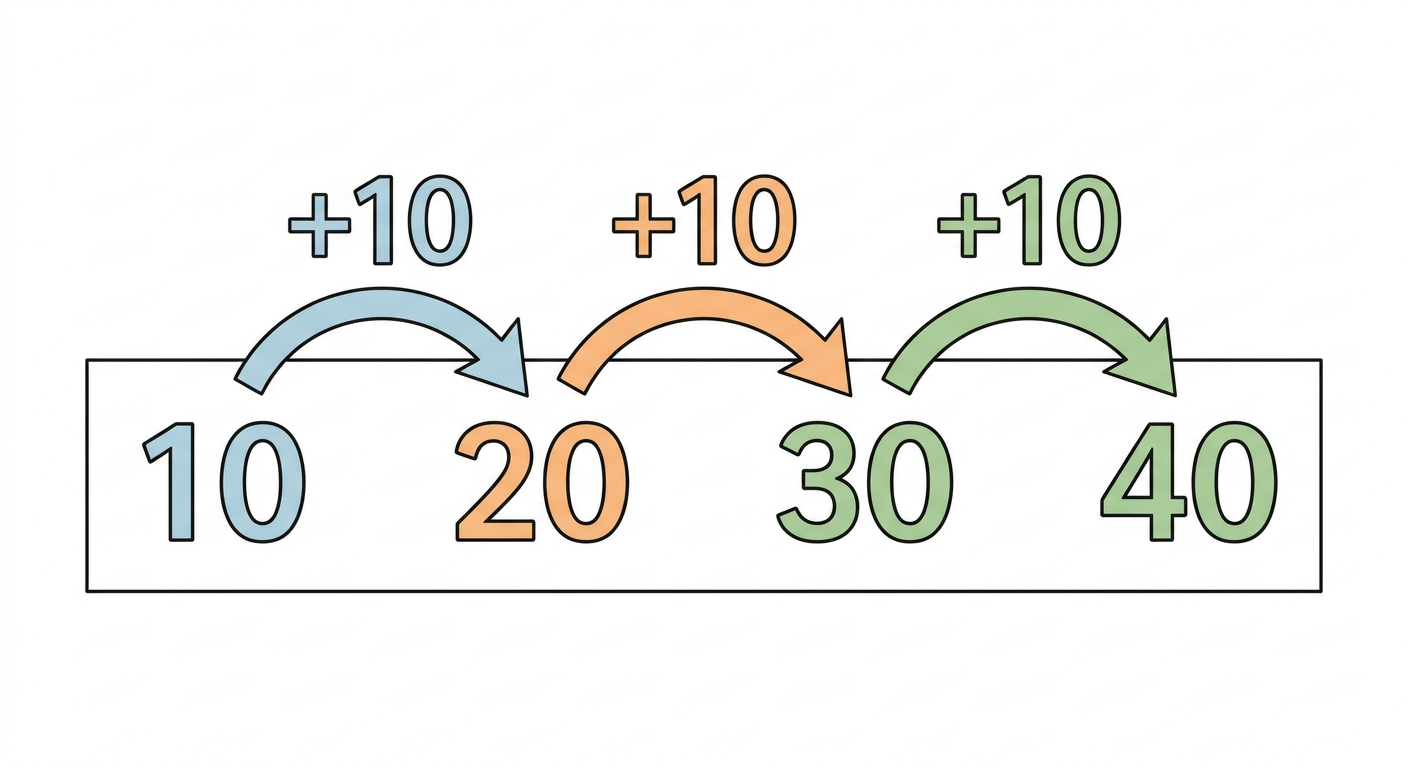
Given a=10a = 10 and d=10d = 10.Diagram 1

a1=a=10a2=a1+d=10+10=20a3=a2+d=20+10=30a4=a3+d=30+10=40\begin{aligned} a_1 &= a = 10 \\ a_2 &= a_1 + d = 10 + 10 = 20 \\ a_3 &= a_2 + d = 20 + 10 = 30 \\ a_4 &= a_3 + d = 30 + 10 = 40 \end{aligned}
Answer

(i) 10,20,30,4010, 20, 30, 40

(ii) a=2,d=0a = -2, \quad d = 0

Step 1 · Find the First Four Terms

Given a=2a = -2 and d=0d = 0.

a1=a=2a2=a1+d=2+0=2a3=a2+d=2+0=2a4=a3+d=2+0=2\begin{aligned} a_1 &= a = -2 \\ a_2 &= a_1 + d = -2 + 0 = -2 \\ a_3 &= a_2 + d = -2 + 0 = -2 \\ a_4 &= a_3 + d = -2 + 0 = -2 \end{aligned}
Answer

(ii) 2,2,2,2-2, -2, -2, -2

(iii) a=4,d=3a = 4, \quad d = -3

Step 1 · Find the First Four Terms

Given a=4a = 4 and d=3d = -3.

a1=a=4a2=a1+d=4+(3)=1a3=a2+d=1+(3)=2a4=a3+d=2+(3)=5\begin{aligned} a_1 &= a = 4 \\ a_2 &= a_1 + d = 4 + (-3) = 1 \\ a_3 &= a_2 + d = 1 + (-3) = -2 \\ a_4 &= a_3 + d = -2 + (-3) = -5 \end{aligned}
Answer

(iii) 4,1,2,54, 1, -2, -5

(iv) a=1,d=12a = -1, \quad d = \dfrac{1}{2}

Step 1 · Find the First Four Terms

Given a=1a = -1 and d=12d = \dfrac{1}{2}.

a1=a=1a2=a1+d=1+12=12a3=a2+d=12+12=0a4=a3+d=0+12=12\begin{aligned} a_1 &= a = -1 \\[0.6em] a_2 &= a_1 + d = -1 + \frac{1}{2} = -\frac{1}{2} \\[0.6em] a_3 &= a_2 + d = -\frac{1}{2} + \frac{1}{2} = 0 \\[0.6em] a_4 &= a_3 + d = 0 + \frac{1}{2} = \frac{1}{2} \end{aligned}
Answer

(iv) 1,12,0,12-1, -\dfrac{1}{2}, 0, \dfrac{1}{2}

(v) a=1.25,d=0.25a = -1.25, \quad d = -0.25

Step 1 · Find the First Four Terms

Given a=1.25a = -1.25 and d=0.25d = -0.25.

a1=a=1.25a2=a1+d=1.25+(0.25)=1.50a3=a2+d=1.50+(0.25)=1.75a4=a3+d=1.75+(0.25)=2.00\begin{aligned} a_1 &= a = -1.25 \\ a_2 &= a_1 + d = -1.25 + (-0.25) = -1.50 \\ a_3 &= a_2 + d = -1.50 + (-0.25) = -1.75 \\ a_4 &= a_3 + d = -1.75 + (-0.25) = -2.00 \end{aligned}
Answer

(v) 1.25,1.50,1.75,2.00-1.25, -1.50, -1.75, -2.00

Common Mistakes
  • Sign Errors with Negative dd: When dd is negative, remember that adding a negative number is equivalent to subtraction (e.g., 4+(3)=14 + (-3) = 1, not 77).
  • Constant Sequence when d=0d = 0: A common difference of 00 means all terms are equal to aa, resulting in a constant sequence.
  • Adding to aa Instead of the Preceding Term: Remember that an=an1+da_n = a_{n-1} + d or an=a+(n1)da_n = a + (n-1)d. Do not simply add dd to aa repeatedly without incrementing the multiplier.

More questions in Exercise 5.1

Q1

In which of the following situations, does the list of numbers involved make an arithmetic progression, and why?

(i) The taxi fare after each km when the fare is ₹ 15 for the first km and ₹ 8 for each additional km.

(ii) The amount of air present in a cylinder when a vacuum pump removes 14\dfrac{1}{4} of the air remaining in the cylinder at a time.

(iii) The cost of digging a well after every metre of digging, when it costs ₹ 150 for the first metre and rises by ₹ 50 for each subsequent metre.

(iv) The amount of money in the account every year, when ₹ 10000 is deposited at compound interest at 8 % per annum.

Q2
  1. Write first four terms of the AP, when the first term aa and the common difference dd are given as follows:

(i) a=10,d=10a = 10, \quad d = 10

(ii) a=2,d=0a = -2, \quad d = 0

(iii) a=4,d=3a = 4, \quad d = -3

(iv) a=1,d=12a = -1, \quad d = \dfrac{1}{2}

(v) a=1.25,d=0.25a = -1.25, \quad d = -0.25

Q3
  1. For the following APs, write the first term and the common difference:

(i) 3,1,1,3,3, 1, -1, -3, \dots

(ii) 5,1,3,7,-5, -1, 3, 7, \dots

(iii) 13,53,93,133,\dfrac{1}{3}, \dfrac{5}{3}, \dfrac{9}{3}, \dfrac{13}{3}, \dots

(iv) 0.6,1.7,2.8,3.9,0.6, 1.7, 2.8, 3.9, \dots

Q4
  1. Which of the following are APs ? If they form an AP, find the common difference dd and write three more terms.

(i) 2,4,8,16,2, 4, 8, 16, \dots

(ii) 2,52,3,72,2, \dfrac{5}{2}, 3, \dfrac{7}{2}, \dots

(iii) 1.2,3.2,5.2,7.2,-1.2, -3.2, -5.2, -7.2, \dots

(iv) 10,6,2,2,-10, -6, -2, 2, \dots

(v) 3,3+2,3+22,3+32,3, 3 + \sqrt{2}, 3 + 2\sqrt{2}, 3 + 3\sqrt{2}, \dots

(vi) 0.2,0.22,0.222,0.2222,0.2, 0.22, 0.222, 0.2222, \dots

(vii) 0,4,8,12,0, -4, -8, -12, \dots

(viii) 12,12,12,12,-\dfrac{1}{2}, -\dfrac{1}{2}, -\dfrac{1}{2}, -\dfrac{1}{2}, \dots

(ix) 1,3,9,27,1, 3, 9, 27, \dots

(x) a,2a,3a,4a,a, 2a, 3a, 4a, \dots

(xi) a,a2,a3,a4,a, a^2, a^3, a^4, \dots

(xii) 2,8,18,32,\sqrt{2}, \sqrt{8}, \sqrt{18}, \sqrt{32}, \dots

(xiii) 3,6,9,12,\sqrt{3}, \sqrt{6}, \sqrt{9}, \sqrt{12}, \dots

(xiv) 12,32,52,72,1^2, 3^2, 5^2, 7^2, \dots

(xv) 12,52,72,73,1^2, 5^2, 7^2, 73, \dots

← Back to Arithmetic Progressions