Question 1
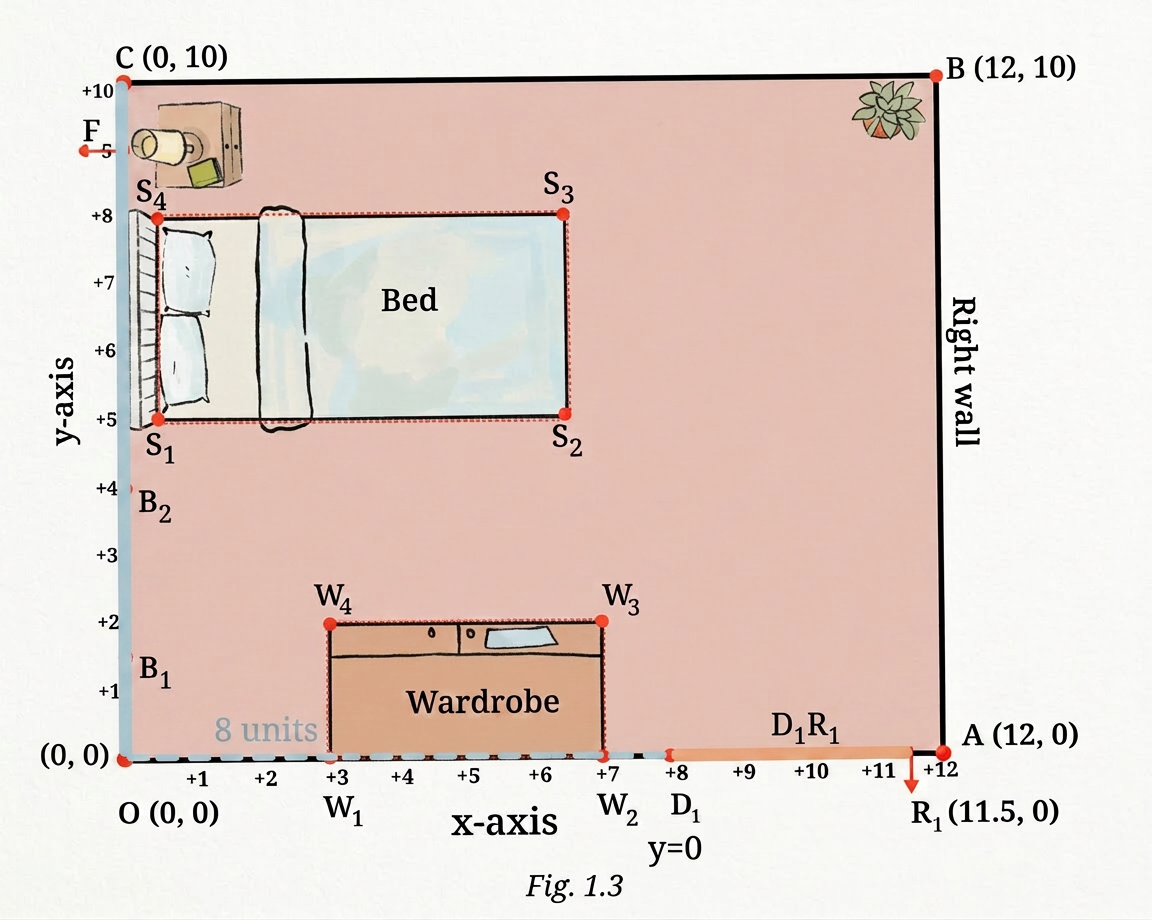
Fig. 1.3 shows Reiaan’s room with points OABC marking its corners. The x- and y-axes are marked in the figure. Point O is the origin.
Referring to Fig. 1.3, answer the following questions:
(i) If represents the door to Reiaan’s room, how far is the door from the left wall (the y-axis) of the room? How far is the door from the x-axis?
(ii) What are the coordinates of ?
(iii) If is the point , how wide is the door? Do you think this is a comfortable width for the room door? If a person in a wheelchair wants to enter the room, will he/she be able to do so easily?
(iv) If and represent the ends of the bathroom door, is the bathroom door narrower or wider than the room door?
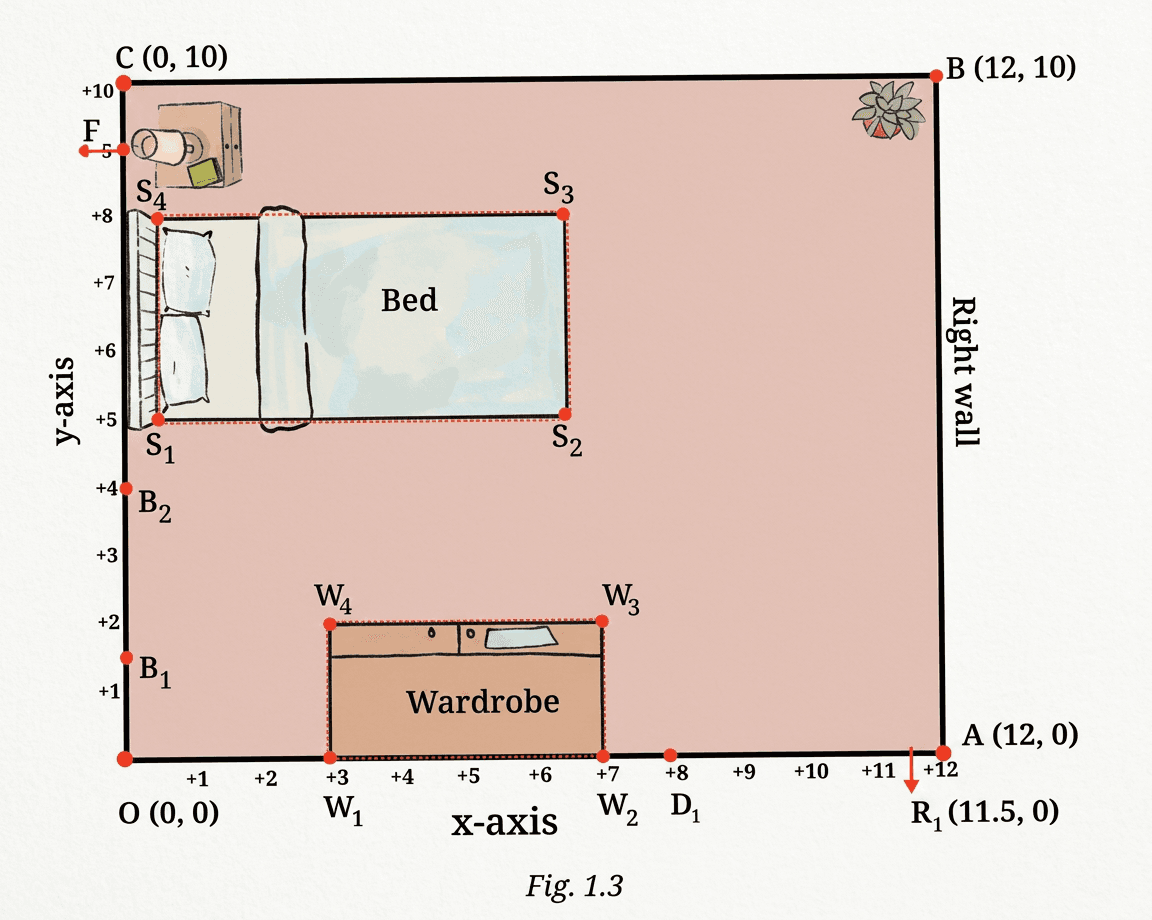
- The room is set on a Cartesian coordinate plane with corner at the origin .
- The left wall lies along the -axis (), so the distance of any point from the left wall is its -coordinate.
- The bottom wall lies along the -axis (), so the distance of any point from the -axis is its -coordinate.
- The width of a door lying along an axis is found by calculating the difference between the coordinates of its two endpoints.
(i) If represents the door to Reiaan’s room, how far is the door from the left wall (the y-axis) of the room? How far is the door from the x-axis?
Step 1 · Find Distance from y-axis and x-axis
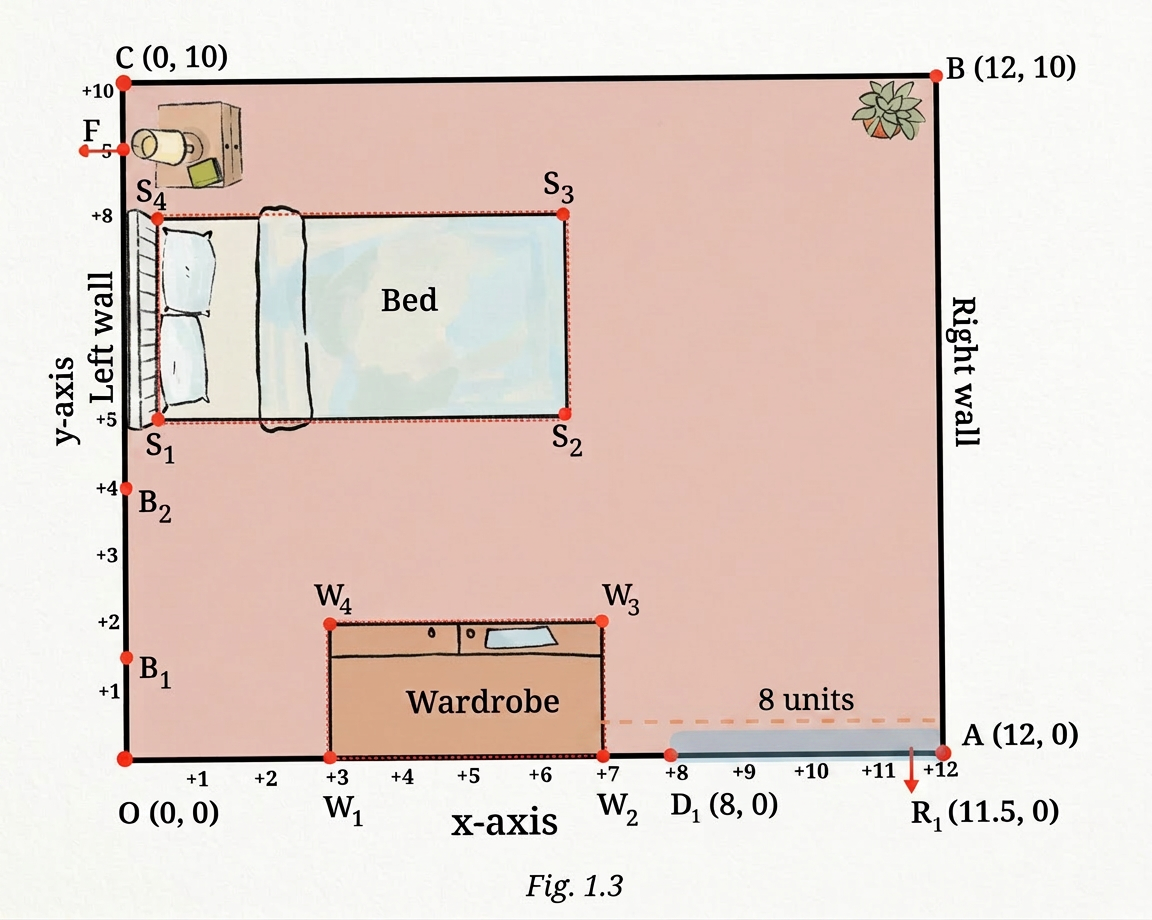
The door starts at point , where and .
(i) Distance from -axis: ; Distance from -axis:
(ii) What are the coordinates of ?
Step 1 · Find Coordinates of
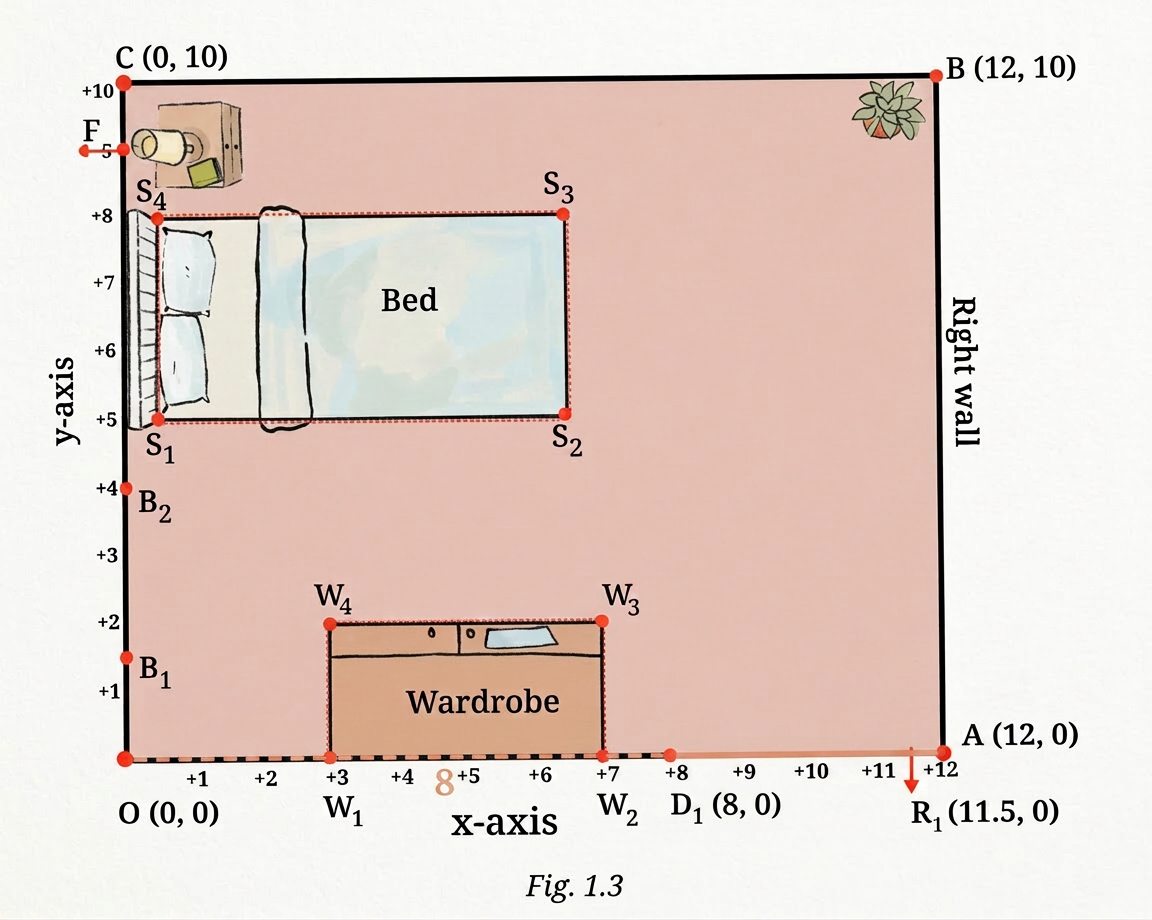
Point lies on the -axis with and :
(ii)
(iii) If is the point , how wide is the door? Do you think this is a comfortable width for the room door? If a person in a wheelchair wants to enter the room, will he/she be able to do so easily?
Step 1 · Calculate Room Door Width and Accessibility
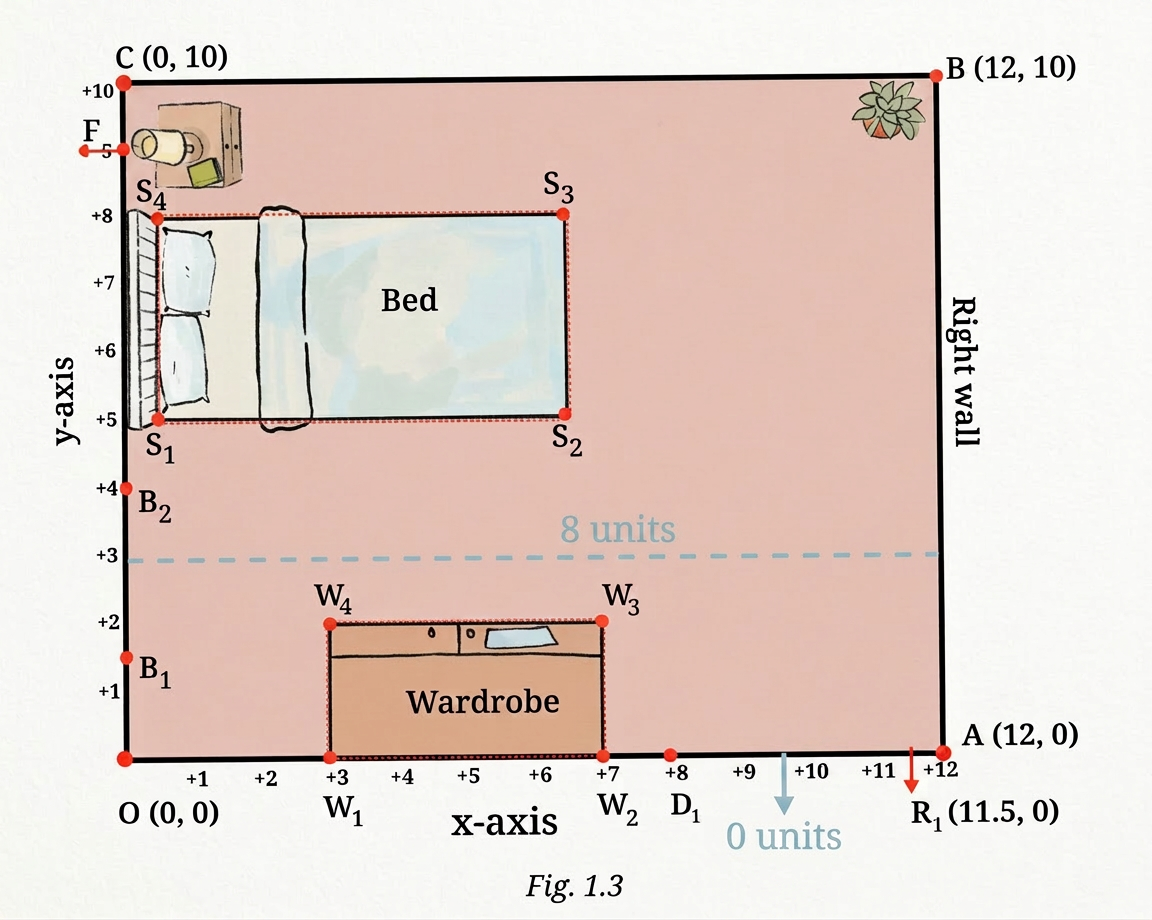
Door width is the difference between the -coordinates of and :
Assuming :
- Door width .
- Standard room doors are , so is very comfortable.
- Standard wheelchair accessibility requires at least . Since , a person in a wheelchair can enter easily.
(iii) Width is (). Yes, it is a comfortable width and easily accessible for a wheelchair.
(iv) If and represent the ends of the bathroom door, is the bathroom door narrower or wider than the room door?
Step 1 · Calculate Bathroom Door Width and Compare
Bathroom door width is the difference between the -coordinates of and :
Comparing door widths:
Therefore, the bathroom door is narrower.
(iv) The bathroom door is narrower than the room door ().
- Axis Inversion: Confusing distance from the -axis with the -coordinate. The distance from the -axis is given by the -coordinate, and the distance from the -axis is given by the -coordinate.
- Points on Axes: Forgetting that any point on the -axis has , so is and not .