Question 1
IT'S PUZZLE TIME!
Coin Conjoin
Arrange 10 coins in a triangle as shown in the figure below on the left. The task is to turn the triangle upside down by moving one coin at a time. How many moves are needed? What is the minimum number of moves?
A triangle of 3 coins can be inverted (turned upside down) with a single move, and a triangle of 6 coins can be inverted by moving 2 coins.
The 10-coin triangle can be flipped with just 3 moves; did you figure out how? Find out the minimum possible moves needed to flip the next bigger triangle having 15 coins. Try the same for bigger triangular numbers.
Is there a simple way to calculate the minimum number of coin moves needed for any such triangular arrangement?
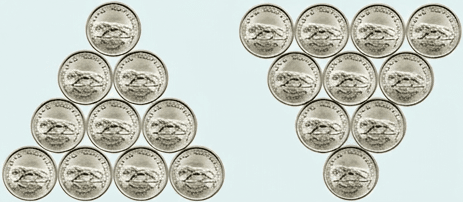
- A triangular arrangement of coins with rows contains a triangular number of coins given by:
- Inverting (turning upside down) a triangular arrangement of rows can be achieved by moving the minimum number of coins, which follows the pattern:
- For any given number of coins , we can determine the number of rows and calculate the required moves.
(i) Find the minimum number of moves needed to turn the 10-coin triangle upside down.
Step 1 · Observe Pattern and Calculate Moves for 10 Coins
The total number of coins in a triangle with rows is .
Comparing rows () and minimum moves:
-
For coins:
-
For coins:
-
For coins:
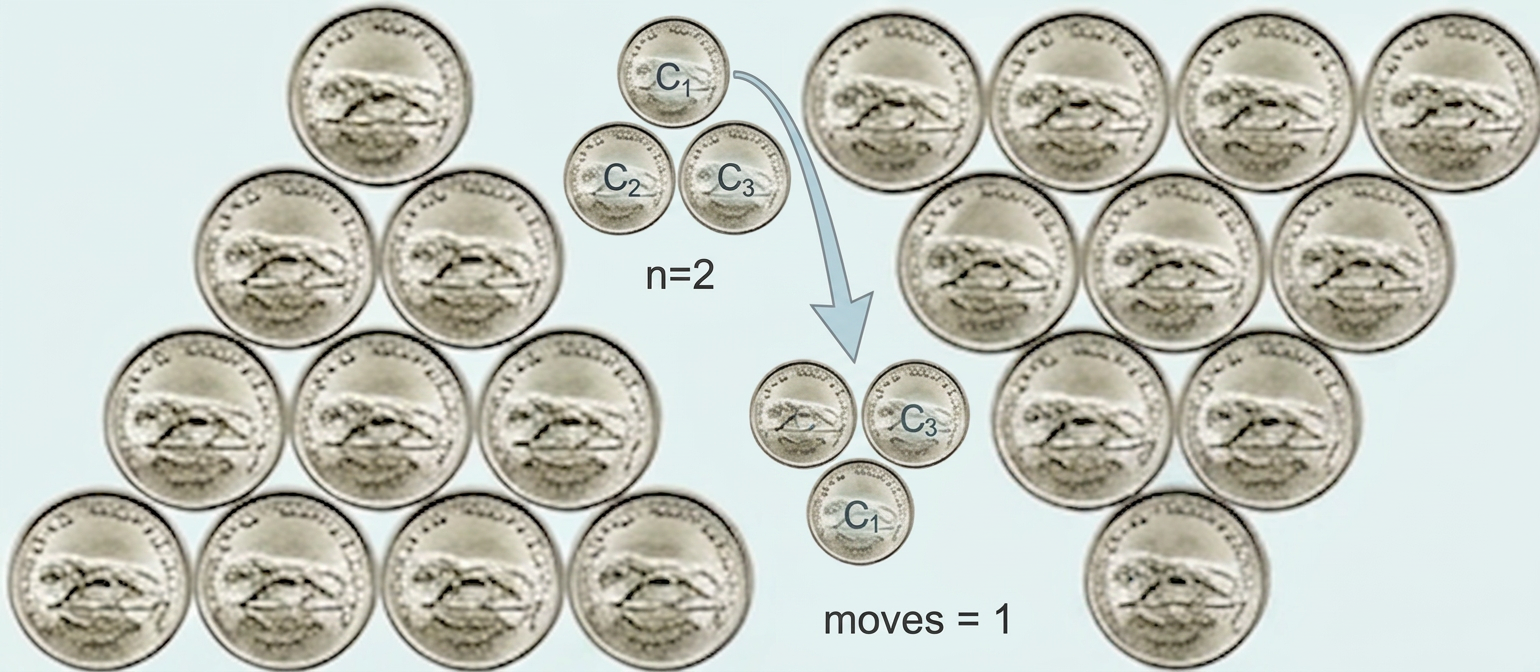
-
For coins ():
- Move top coin below and .
- Moves required .
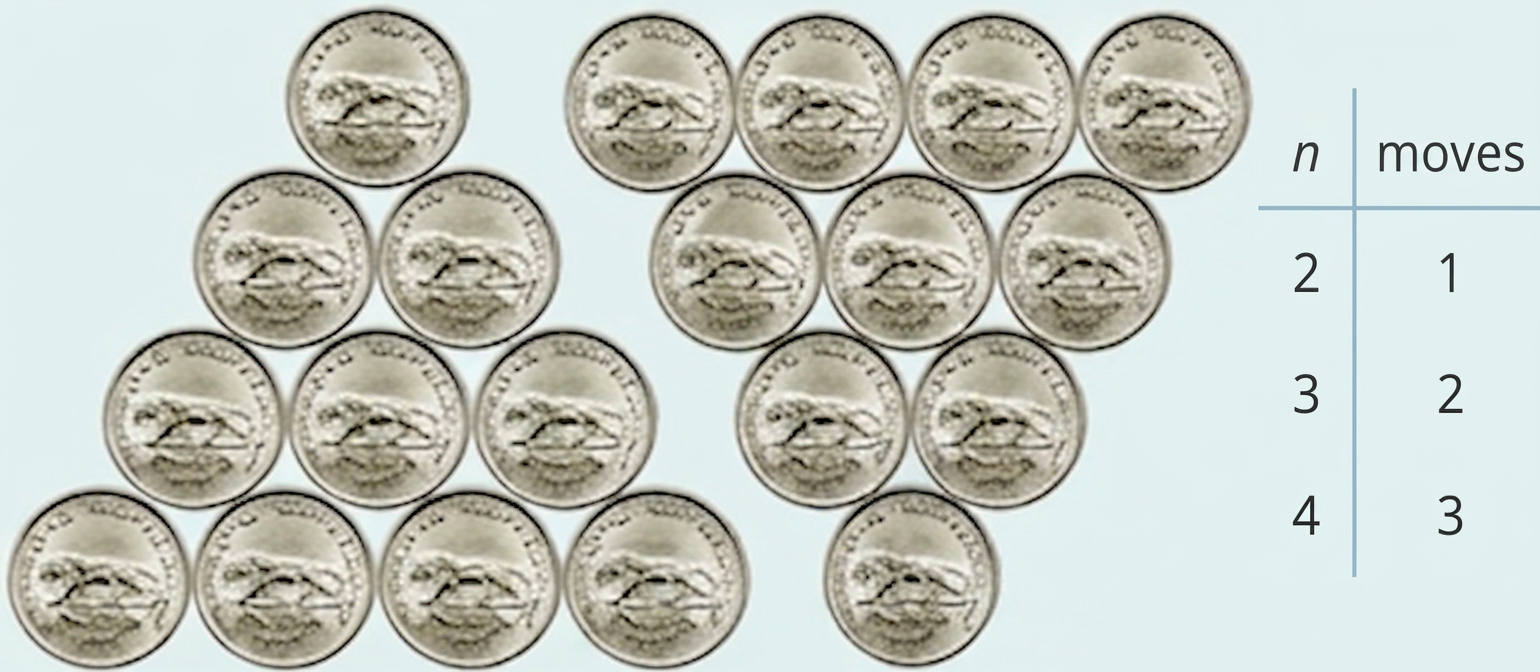
- For coins ():
- Move top coin and bottom-right coin .
- Moves required .
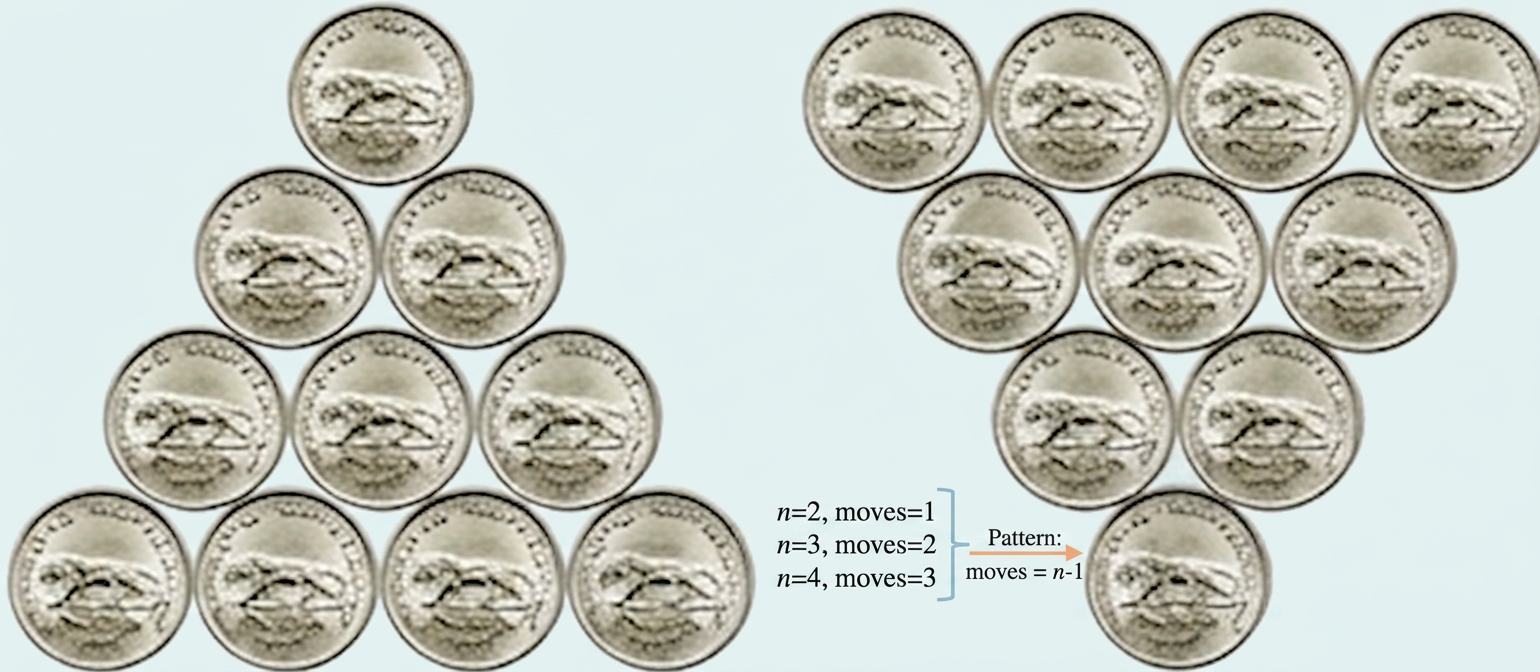
- For coins ():
- Move top coin , bottom-left coin , and bottom-right coin .
- Moves required .
(i)
(ii) Find the minimum possible moves needed to flip the next bigger triangle having 15 coins.
Step 1 · Find Number of Rows and Compute Moves for 15 Coins
Given total coins .
Since , the number of rows is .
(ii)
(iii) Find a simple way to calculate the minimum number of coin moves needed for any such triangular arrangement.
Step 1 · Derive General Formula in Terms of Total Coins
For a triangle with rows, the minimum moves required is .
To express this in terms of total coins :
Using the quadratic formula with :
Substituting into :
(iii)
- Moving Interior Coins: Attempting to move interior coins instead of corner/boundary coins, which leads to extra moves.
- Confusing with : Using the total number of coins in place of the number of rows in the simple formula .