Question 1
Create your own calendar trick. For instance, choose a grid of a different size and shape.
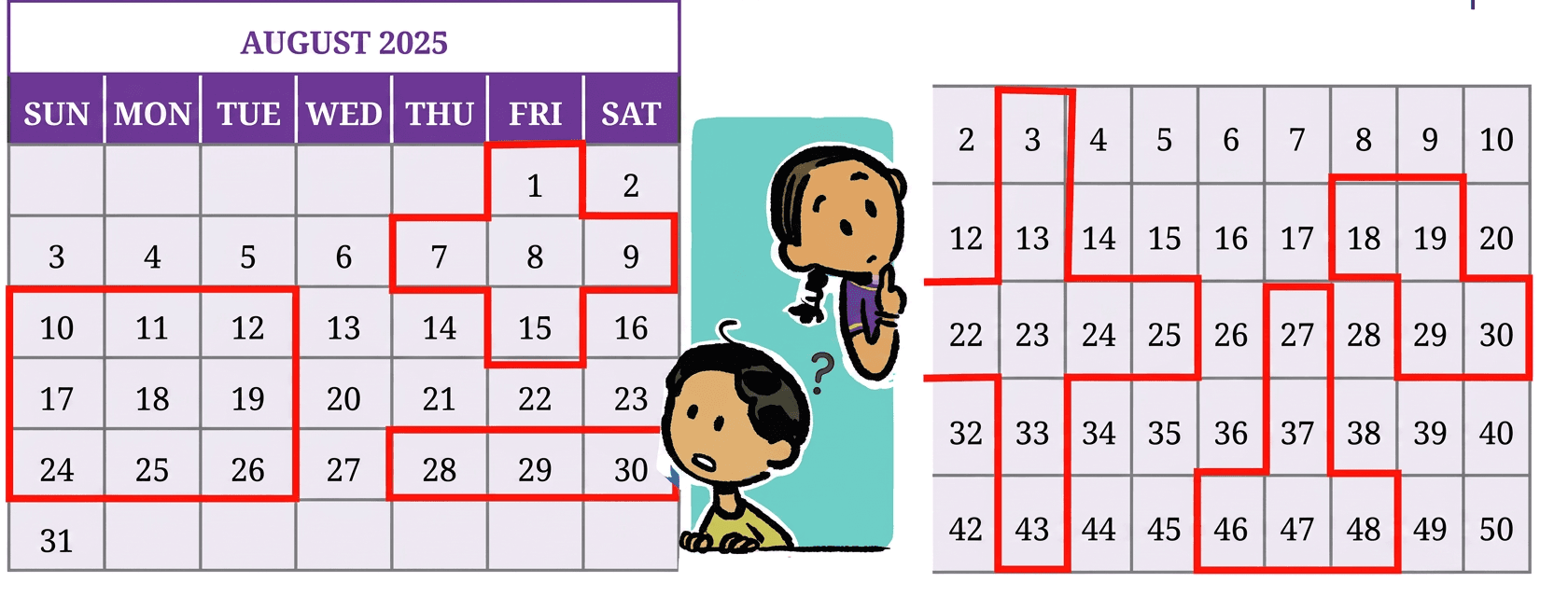
- In a standard monthly calendar, consecutive numbers in a row differ by (day-to-day), and consecutive numbers in a column differ by (week-to-week).
- We can design calendar tricks by choosing a geometric shape or grid, expressing each date algebraically in terms of a single variable, and calculating their sum to find a simplified formula.
Step 1 · Cross-Shaped Grid Trick
Let be the number in the center of a cross-shaped grid of five dates:
- Above:
- Below:
- Left:
- Right:
- Center:
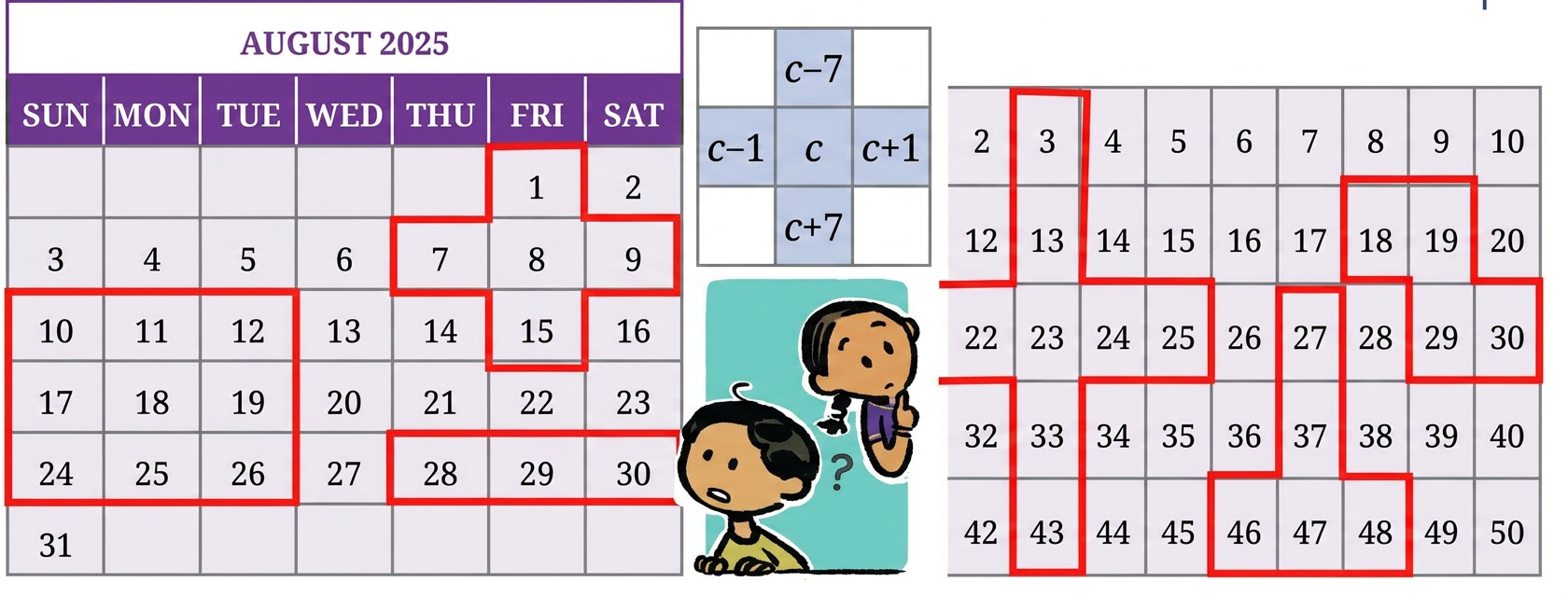
Sum of the five numbers
Thus, the sum is always times the center number.
Example: For a cross centered at with numbers
Step 2 · Square Grid Trick
Let be the top-left number in a square grid of nine dates:
- Row 1:
- Row 2:
- Row 3:
The center number is .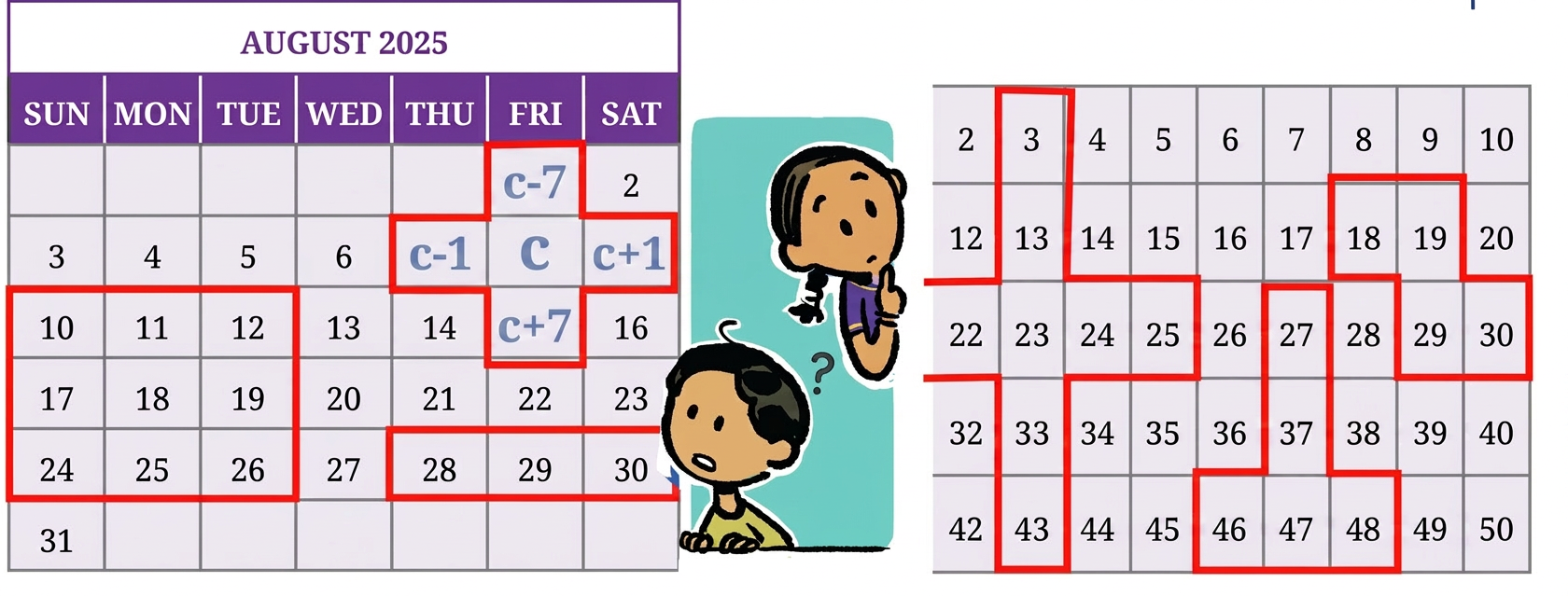
Sum of all nine numbers
Thus, the sum is always times the center number ().
Example: For a grid with top-left number and center
Step 3 · Horizontal Grid Trick
Let be the leftmost number in a horizontal row of three consecutive dates: . The middle number is .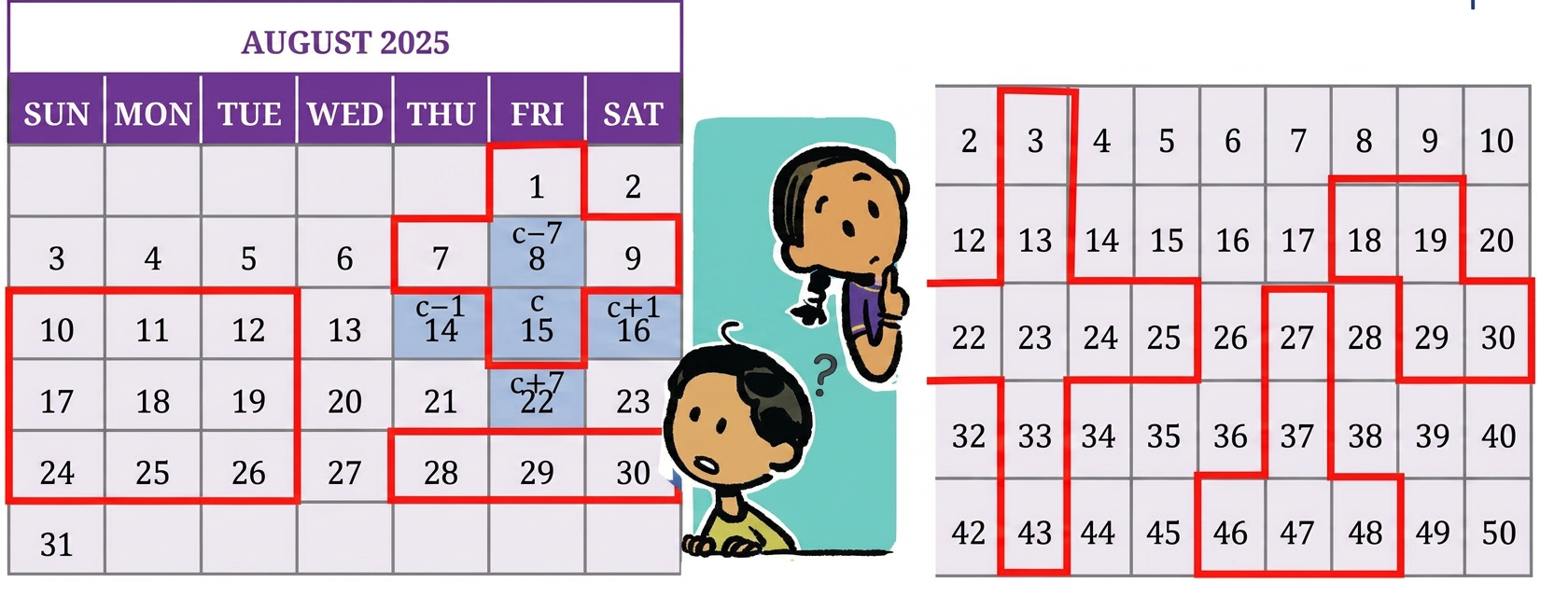
Sum of the three numbers
Thus, the sum is always times the middle number ().
Example: For dates with middle number
- Cross-shaped grid: ( times the center number)
- grid: ( times the center number)
- horizontal grid: ( times the middle number)
- Row Offset Error: Forgetting that moving down one row in a weekly calendar adds rather than .
- Center vs. Starting Value: Confusing the top-left value with the center number in a grid when computing the multiplier.
- Month Boundaries: Selecting grids that cross over the end or start of a month where the regular / pattern breaks.