Question 1
Consider the following situation.
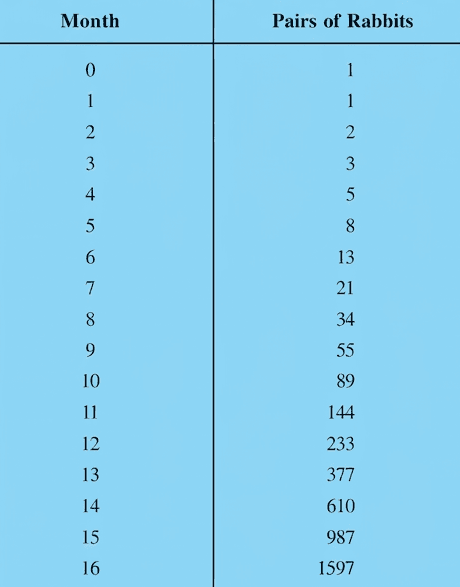
A problem dating back to the early 13th century, posed by Leonardo Fibonacci asks how many rabbits you would have if you started with just two and let them reproduce. Assume that a pair of rabbits produces a pair of offspring each month and that each pair of rabbits produces their first offspring at the age of 2 months. Month by month the number of pairs of rabbits is given by the sum of the rabbits in the two preceding months, except for the 0th and the 1st months.
After just 16 months, you have nearly 1600 pairs of rabbits! Clearly state the problem and the different stages of mathematical modelling in this situation.
- Mathematical modelling is the process of translating a real-world problem into mathematical equations, solving them, and interpreting the results in the real-world context.
- For the Fibonacci rabbit problem, we progress through four key stages:
- Problem Formulation: Understand the given reproduction rules, assumptions, and the goal.
- Mathematical Formulation: Represent the population at month using a recurrence relation ( with ).
- Solving the Model: Compute the sequence values up to month .
- Interpretation & Validation: Relate the mathematical result ( pairs) back to reality and identify limitations (such as ignoring mortality and resource limits).
Step 1 · Stage 1: Formulate the Problem
Problem Statement: Find the total number of rabbit pairs after months given an initial starting pair and specific reproduction rules.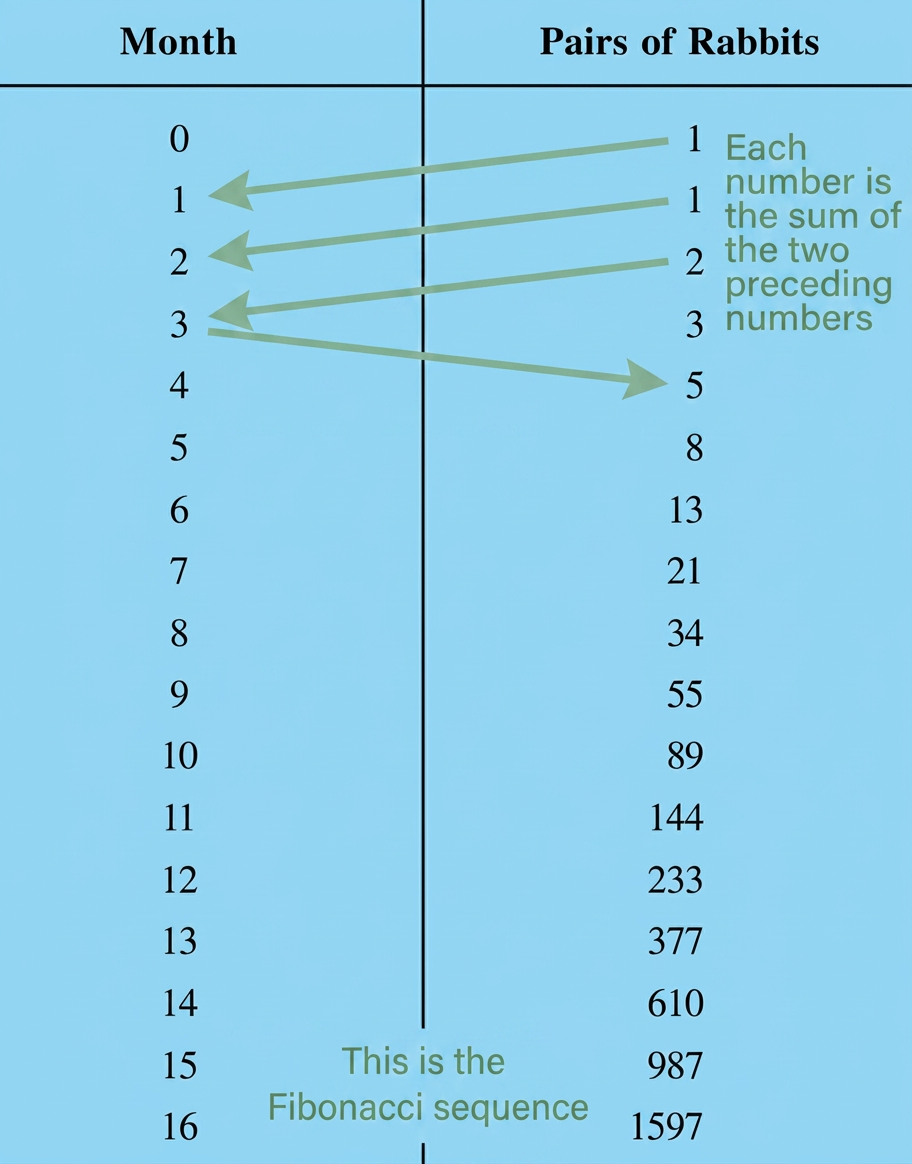
Assumptions:
- Start with newborn pair of rabbits at month .
- A pair matures and starts reproducing at age months.
- Each mature pair produces new pair every month.
- Rabbits do not die during the months.
Step 2 · Stage 2: Mathematical Formulation
Let denote the number of rabbit pairs at the end of month .
- At month :
- At month :
- For month : The total pairs equal the pairs alive in the previous month plus the new pairs born (produced by pairs that were alive two months ago):
Step 3 · Stage 3: Solve the Model
Using the recurrence relation :
Step 4 · Stage 4: Interpretation and Validation
- Interpretation: The model calculates that after months, there will be pairs of rabbits (nearly pairs).
- Validation: While mathematically consistent, this model is an idealisation because real populations face mortality, diseases, aging, and limited space/food resources.
The four stages of mathematical modelling are:
- Problem Formulation: Defining the rabbit growth rules and setting the goal to find population at months.
- Mathematical Formulation: Establishing the Fibonacci recurrence with .
- Solving the Model: Calculating pairs.
- Interpretation and Validation: Understanding rapid exponential growth while noting biological constraints like mortality.
- Counting Individual Rabbits instead of Pairs: The problem defines counts in terms of pairs of rabbits, not individual rabbits.
- Starting Index Confusion: Forgetting that rabbits take months to mature, meaning and , so new births only start from month ().
- Omitting Assumptions: Neglecting real-world constraints such as zero mortality and unlimited resources that are necessary for this mathematical model to hold.